

In a groundbreaking experiment at CERN’s Large Hadron Collider (LHC), researchers have, for the first time, directly observed high-energy neutrino interactions in the teraelectronvolt (TeV) energy range. This historic achievement was made possible through the Forward Search Experiment (FASER), which successfully captured interactions of electron and muon neutrinos at unprecedented energy levels.
Neutrinos, often dubbed “ghost particles” due to their extremely small masses and weak interactions with matter, have long intrigued physicists. These elusive particles are abundant—trillions pass through our bodies every second—yet they are notoriously difficult to detect. This new discovery marks a significant milestone in particle physics, offering a fresh perspective on these enigmatic particles.
Akitaka Ariga, an associate professor at Chiba University and one of the research leads, emphasized the importance of this achievement, describing it as “a breakthrough in particle physics that could revolutionize the strategy of large-scale experimental research in the field.”
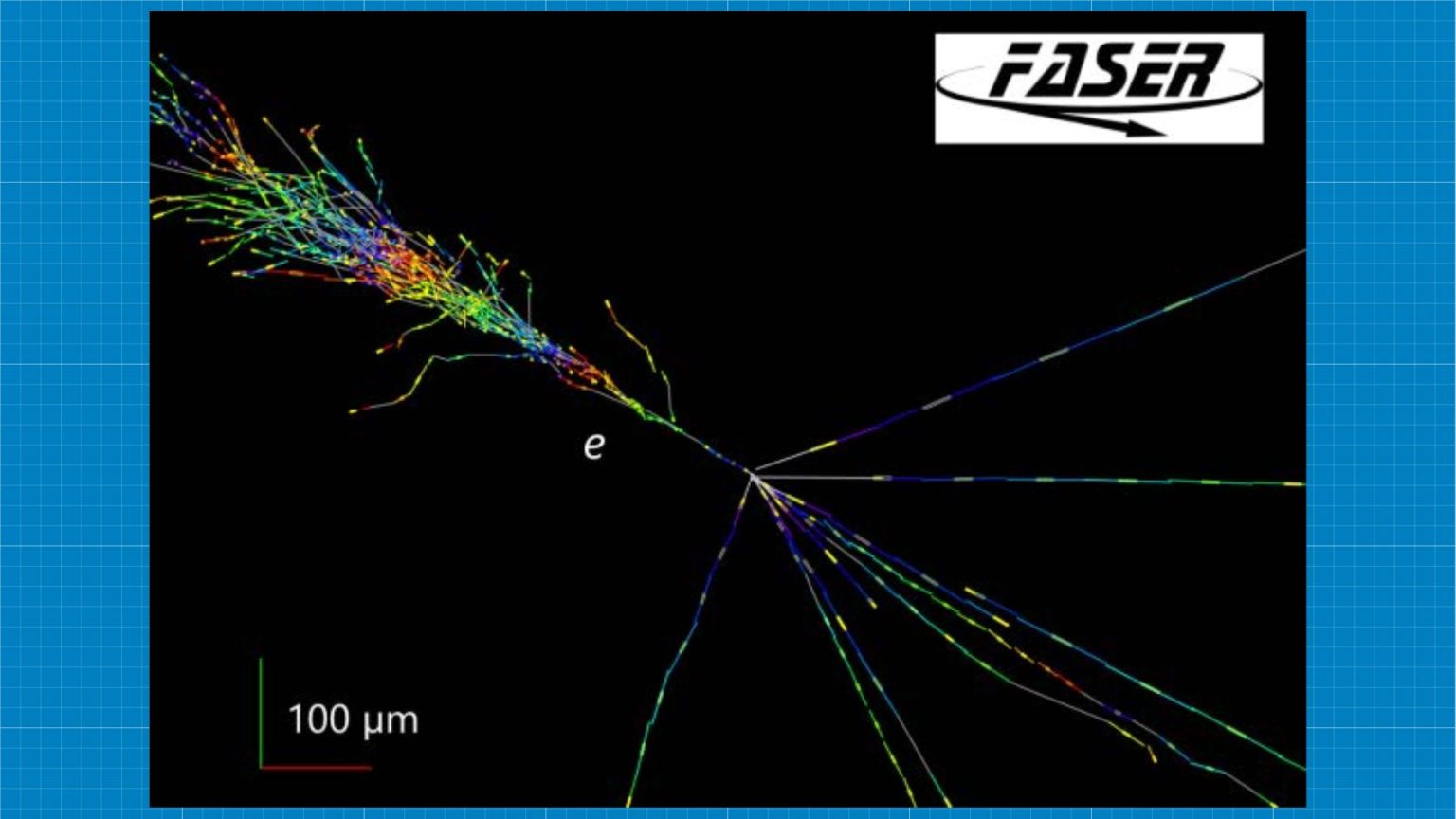
The success of this experiment hinges on the FASERν detector, a specialized component of the FASER experiment at CERN. The FASERν detector is composed of 730 layers of tungsten plates and emulsion films, with a total target mass of 1.1 tons. This intricate design allows for the reconstruction of charged particle tracks resulting from neutrino interactions with sub-micron precision.

The research team analyzed a subset of the detector’s exposed volume, equivalent to 128.6 kilograms, focusing on high-energy neutrinos produced by proton-proton collisions at the LHC. Through rigorous selection criteria, they identified four electron neutrino and eight muon neutrino interaction candidates, all with energies exceeding 200 GeV. The statistical significance of these observations—5.2σ for electron neutrinos and 5.7σ for muon neutrinos—strongly indicates that they are genuine neutrino interactions, rather than background noise.
The detected neutrinos are the highest-energy neutrinos ever observed from an artificial source, with energies in the TeV range. This study provides the first measurements of neutrino interaction cross-sections—the probability of neutrinos interacting with target particles—at energy levels between 560–1740 GeV for electron neutrinos and 520–1760 GeV for muon neutrinos. These measurements fill a critical gap in the existing data, extending beyond the 300 GeV limit for electron neutrinos and the 400 GeV to 6 TeV range for muon neutrinos, and are consistent with Standard Model predictions.
This ability to study neutrinos at such extreme energies opens new avenues for exploring fundamental questions in physics, such as the origins of particle mass and the mystery of why there is more matter than antimatter in the universe. The success of this experiment at CERN marks a pivotal step forward in our understanding of the universe’s most elusive particles.