

More than 300 humanoid robots raced through the streets of Beijing’s Yizhuang district on Sunday, with the winning machine completing a half marathon faster than any human ever has. It was a striking reversal from just one year ago, when robots could barely finish the course without falling over or shutting down halfway through the race.
Honor, the Chinese smartphone and device maker, claimed victory with its humanoid robot called Lightning, which crossed the finish line with a net time of around 50 minutes, according to reports from Reuters and local media. That pace was several minutes faster than the current human world record for the half marathon, set by Uganda’s Jacob Kiplimo at 57 minutes and 20 seconds in Lisbon last month. In a moment that felt almost cinematic, Lightning stumbled into a railing just meters from the finish line, but after a quick assist from staff it got back up and completed the race to lock in the historic win.
The improvement over last year was nothing short of dramatic. In the inaugural 2025 edition, only 21 robots competed and just 6 managed to finish the 21 kilometer course, with the rest stumbling, overheating, or running out of power before the end. The winning robot that year, Tiangong Ultra, completed the race in 2 hours and 40 minutes, more than double the time of the fastest human runner. Fast forward just one year, and a humanoid robot is now beating the human world record itself.
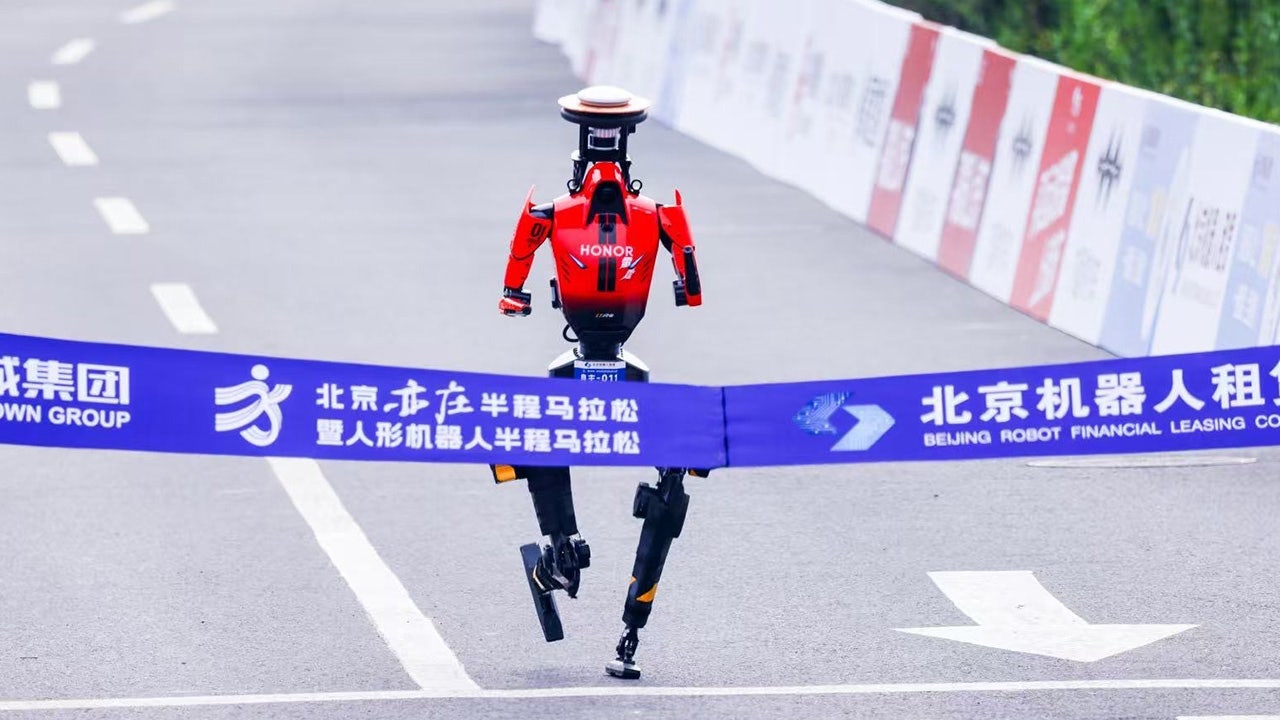
This year’s event drew over 100 teams from dozens of organizations across China, along with several international groups, and a total of more than 300 humanoid robots lined up at the start line. Many of the robots ran the course autonomously using onboard artificial intelligence, a new category introduced this year alongside the existing remote control format. The route was also made more demanding, with additional turns and steeper gradients to really push the machines to their limits. Human runners took part in associated events on the same route but on separate tracks divided by guardrails, creating one of the most unusual race day scenes in sports history.
The race is part of Beijing’s bigger push to turn humanoid robotics into a key pillar of its economy. Companies like Honor and Unitree Robotics are racing to improve speed, balance, and endurance, with one CEO even predicting humanoid robots could break the 10 second barrier in the 100 meter dash by the middle of 2026. The event was jointly organized by the Beijing Municipal Government and China Central Television, and it highlighted just how quickly the gap between robot and human athletic performance is closing. The impact stretches far beyond sport, with clear implications for logistics, healthcare, elder care, and disaster response in the years ahead.
Just 12 months ago, the idea of a robot beating the human half marathon record felt like science fiction. Today, it is reality. Whether you see it as exciting, unsettling, or both, the message from Beijing is clear. Humanoid robots are no longer stumbling curiosities. They are running, learning, and now even outpacing us in ways that were hard to imagine only a year ago. And if this year’s race is any sign of what’s coming next, the future of robotics may arrive much sooner than anyone expected.