

Key Takeaways
- Comet 3I/ATLAS has grown brighter and greener since its solar flyby in late October.
- New images were captured on November 26 by the Gemini North telescope in Hawaii.
- The green glow comes from diatomic carbon (C2) gas released as the comet heats up.
- The comet will pass within 170 million miles (270 million km) of Earth on December 19.
- 3I/ATLAS is only the third interstellar object ever detected in our solar system.
Astronomers are watching interstellar comet 3I/ATLAS closely as it becomes more active on its journey through the inner solar system. Fresh images from the Gemini North telescope reveal the comet shining brighter and taking on a noticeable green tint, a clear sign that solar heating is driving new material off its surface.
As sunlight warms the comet, frozen gases inside begin to sublimate, releasing dust and gas into space. This process forms a glowing cloud, known as a coma, around the comet’s nucleus and stretches a luminous tail behind it. By observing the comet through multiple color filters, researchers detected a faint green glow that was not present just a few months ago.
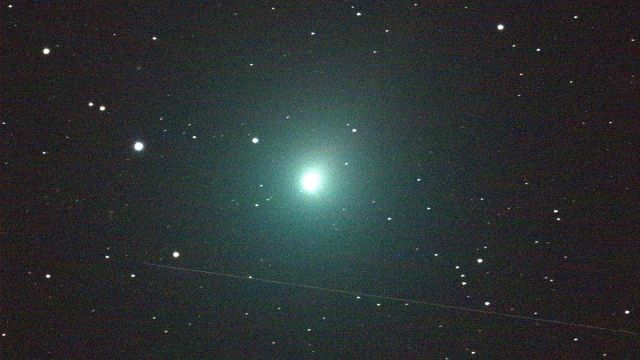
That green color comes from diatomic carbon, a common gas seen in many active comets when they approach the Sun. Similar green hues were observed in other recent comets, including 12P/Pons-Brooks and Comet C/2025 F2 (SWAN). What makes 3I/ATLAS especially interesting is that earlier observations showed it appearing much redder, suggesting that new molecules are now being released as deeper layers heat up.
The comet will make its closest approach to Earth on December 19, passing at a safe distance of about 170 million miles. While there is no danger to our planet, astronomers say the encounter could bring surprises. Some comets respond slowly to solar heating, which means additional jets or sudden outbursts could still occur even as the comet begins to cool.
3I/ATLAS holds special significance because it is only the third interstellar object ever discovered, following ‘Oumuamua and Borisov. It was first spotted in late June, racing through the solar system at around 130,000 miles per hour on a one-time path that will never return.
Despite online speculation, scientists agree the object is a natural comet, not alien technology. Its behavior fits well with known comet physics, though its extreme age and long exposure to interstellar space make it a rare scientific opportunity.
With observatories around the world tracking 3I/ATLAS, researchers hope to learn more about how comets form around other stars and what they can tell us about the early history of the Milky Way.