

The James Webb Space Telescope has just delivered a cosmic milestone that reshapes our understanding of the universe. Through its COSMOS-Web program, JWST has unveiled the largest and most detailed map of the universe ever created, charting nearly 800,000 galaxies across 13.5 billion years of cosmic history. The new map spans a time period that accounts for about 98% of the universe’s age and captures light from galaxies that formed as early as 300 million years after the Big Bang.
Covering a portion of the sky roughly three times the size of a full moon, this panoramic map is a monumental achievement for a telescope designed to look deeper into space than anything before it. Using its unmatched infrared sensitivity, JWST has detected ancient and faint galaxies that were previously invisible, even to the powerful Hubble Space Telescope. The COSMOS-Web data reveals an unexpectedly rich and crowded early universe—about ten times more galaxies than astronomers predicted at such vast distances.
The new map does more than just expand our view—it challenges existing theories of early galaxy formation. Alongside the flood of new galaxies, JWST has uncovered supermassive black holes in the early universe, offering clues to how these massive objects formed and evolved so rapidly. These findings suggest that galaxy formation in the early universe may have occurred faster and more energetically than previously thought.
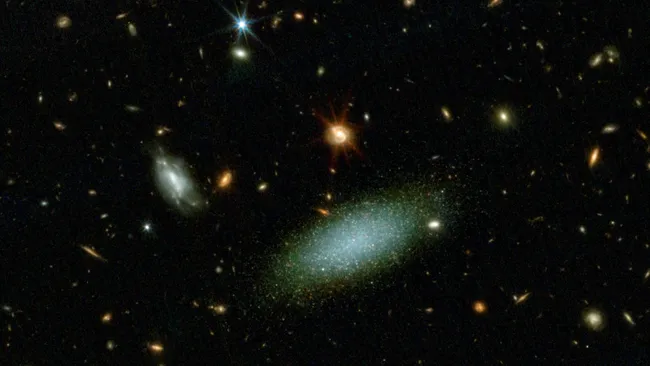
One of the most remarkable aspects of this achievement is its accessibility. The COSMOS-Web team has made the entire 1.5 terabyte dataset publicly available, including an interactive map viewer. This allows not only professional astronomers but also educators, students, and space enthusiasts to explore the distant universe in exquisite detail. The project is a prime example of open science in action, turning one of the most advanced scientific efforts into a global experience.
The COSMOS-Web program is the largest observing effort JWST has undertaken in its first year of operation. Its scientific goals are just as ambitious as the scale of the map itself. Researchers are using the data to study the reionization era, a crucial period in cosmic history when the first galaxies lit up and ionized the fog of hydrogen that had filled the universe since the Big Bang. The program also aims to trace the evolution of massive galaxies during the first two billion years of cosmic time and to understand how dark matter and stellar content are connected in the formation of galaxies.
This groundbreaking map is only the beginning. As more observations continue and JWST’s capabilities are fully realized, scientists expect even deeper insights into the origins of galaxies, the structure of the early universe, and the invisible forces like dark matter that shaped everything we see today. With COSMOS-Web, the James Webb Space Telescope has not only expanded our view of the universe—it has rewritten the cosmic story with more detail and depth than ever before.