

Scientists utilizing the James Webb Space Telescope (JWST) have made a groundbreaking discovery by detecting carbon dioxide (CO₂) on the frozen surface of Charon, Pluto’s largest moon, for the first time. This revelation, announced on Tuesday, also includes the detection of hydrogen peroxide (H₂O₂), providing new insights into the icy worlds situated in the enigmatic outer reaches of our Solar System.
Pluto, once celebrated as the ninth planet from the Sun, was reclassified as a dwarf planet in 2006 after the identification of numerous similar objects in the Kuiper Belt, a doughnut-shaped region beyond Neptune believed to harbor millions of icy bodies. Silvia Protopapa of the Southwest Research Institute in Colorado, who led the study published in Nature Communications, emphasized the significance of these findings by stating that “objects in the Kuiper Belt are time capsules that enable us to understand the formation of the Solar System.”
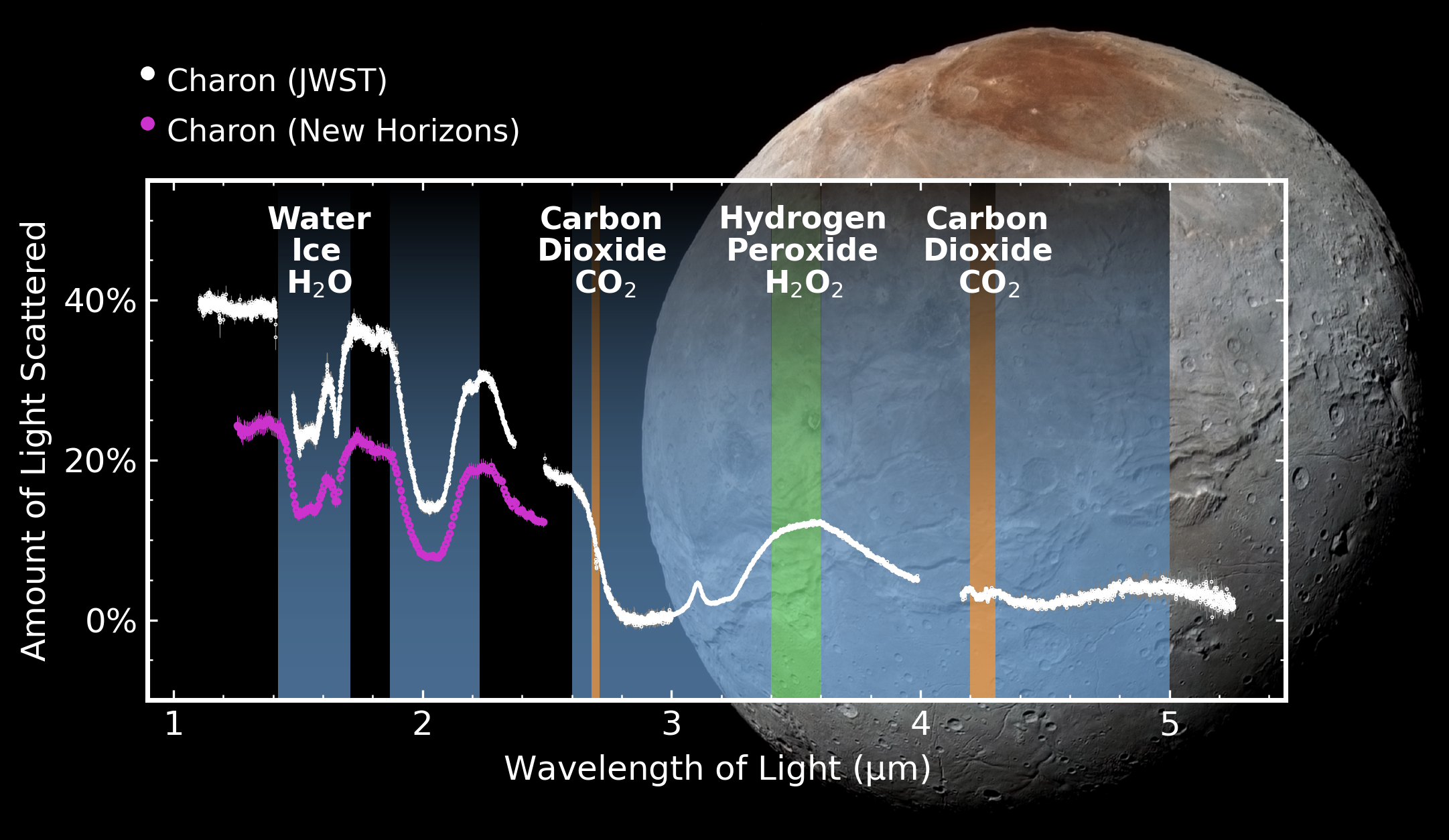
Charon offers a unique perspective into these distant worlds because, unlike other Kuiper Belt objects and Pluto itself, its surface is not obscured by highly volatile ices such as methane. This clarity allows for more detailed chemical analysis. The discovery of CO₂ on Charon is particularly intriguing as it is a crucial gas for life on Earth and suggests that similar processes may have been at work during the formation of these celestial bodies. Previously, the New Horizons spacecraft, which flew by Charon in 2015, identified the moon’s surface composition primarily as water ice and ammonia, revealing red and grey hues and occasional exposures of subsurface material through craters. However, it did not detect CO₂, leaving an open question that JWST has now addressed.
The JWST’s ability to measure longer wavelengths of light enabled it to probe deeper into Charon’s icy surface, uncovering the presence of CO₂ in its solid form, also known as dry ice. This capability surpasses the limitations of the New Horizons mission, which was unable to detect these gases. Additionally, the unexpected discovery of hydrogen peroxide suggests that Charon’s surface is being altered by ultraviolet light and solar wind from the distant Sun, indicating ongoing chemical processes that modify its icy terrain.
The presence of these chemicals on Charon not only fills a critical gap in our understanding of Kuiper Belt objects but also provides valuable clues about the conditions present during the early formation of the Solar System. The protoplanetary disc, a swirling mass of gas and dust that surrounded the young Sun around 4.5 billion years ago, is believed to have contained CO₂, and finding this gas on Charon helps piece together the history of our celestial neighborhood.
As researchers continue to analyze the data from JWST, the findings on Charon will undoubtedly contribute to a more comprehensive understanding of the composition and evolution of icy moons and dwarf planets. This discovery highlights the advanced capabilities of the James Webb Space Telescope in exploring and uncovering the mysteries of our Solar System’s outer regions, paving the way for future studies that could reveal even more about these frozen worlds and their role in the broader context of planetary science.