

Key Takeaways
- Researchers have found the strongest evidence to date of a “critical point” in nuclear matter, a fundamental milestone similar to mapping the points where water changes from liquid to gas.
- The discovery offers new insights into quark-gluon plasma, the super-hot, dense soup of particles that existed just 10 microseconds after the universe began.
- New computer models are providing unprecedented detail about this primordial matter, aligning more closely with experimental data from particle colliders.
- These advances are the result of large international collaborations, combining experimental data from facilities like Brookhaven and CERN with cutting-edge theoretical work.
Scientists have made a monumental leap in understanding the very first moments of our universe, revealing new details about the primordial soup of matter that existed microseconds after the Big Bang. New findings from international research teams provide the most precise evidence yet of a “critical point” in this nuclear matter, a discovery that helps map the fundamental phases of existence.
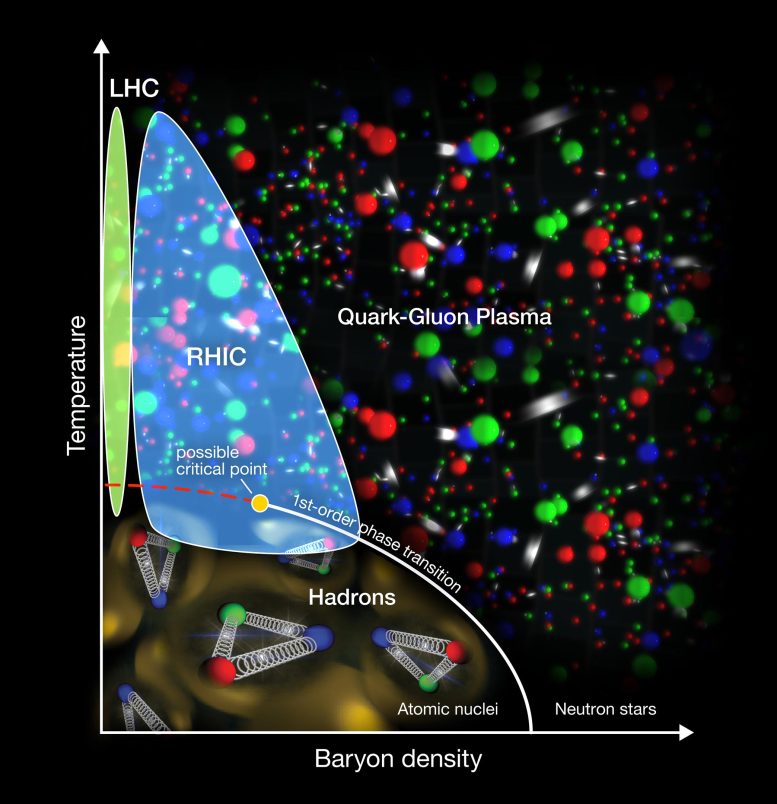
Just after the Big Bang, the universe was filled with a super-hot, incredibly dense state of matter called quark-gluon plasma, where the fundamental building blocks of protons and neutrons roamed freely. At facilities like Brookhaven National Laboratory, scientists recreate these extreme conditions by smashing gold ions together at nearly the speed of light.
The STAR collaboration at Brookhaven announced they have detected subtle fluctuations in the particles produced during these collisions, which signal a phase change in nuclear matter. These fluctuations are the signature of a “critical point”—a landmark on the nuclear phase diagram, much like the specific temperature and pressure at which water turns to steam.
“Finding the critical point would put a landmark on the nuclear phase diagram,” said Xiaofeng Luo, one of the analysis leaders from Central China Normal University. “It would mark a fundamental milestone in our understanding of how matter behaves under extreme conditions—from the birth of the universe to the cores of neutron stars.”
Complementing this experimental breakthrough, researchers at the University of Jyväskylä in Finland have developed advanced computer models that solve complex equations describing this early universe matter. “This research helps reveal how nuclear matter behaves under extreme conditions,” explained Associate Professor Heikki Mäntysaari. Their improved models align better with experimental data, offering a clearer window into how quark-gluon plasma is formed.
These discoveries are a testament to global scientific collaboration and set the stage for even deeper insights with the upcoming Electron-Ion Collider, which will allow scientists to further probe the fundamental forces that bind our universe together.