

In 2029, Earth is set to have a close encounter with a 375-meter-wide asteroid known as Apophis, and the European Space Agency (ESA) intends to send a spacecraft to follow the hurtling space rock as it flies by our planet. ESA has confirmed that preparatory work will begin for the Rapid Apophis Mission for Space Safety (Ramses), with a decision on whether the mission will go ahead to be made in November 2025.
Ramses would rendezvous with the asteroid—full name 99942 Apophis—and follow it as it zips by Earth at a distance of just 32,000 kilometers (19,900 miles) on April 13, 2029. The Ramses spacecraft will provide scientists on the ground with valuable data, including revealing how Earth’s gravity alters the asteroid’s characteristics.
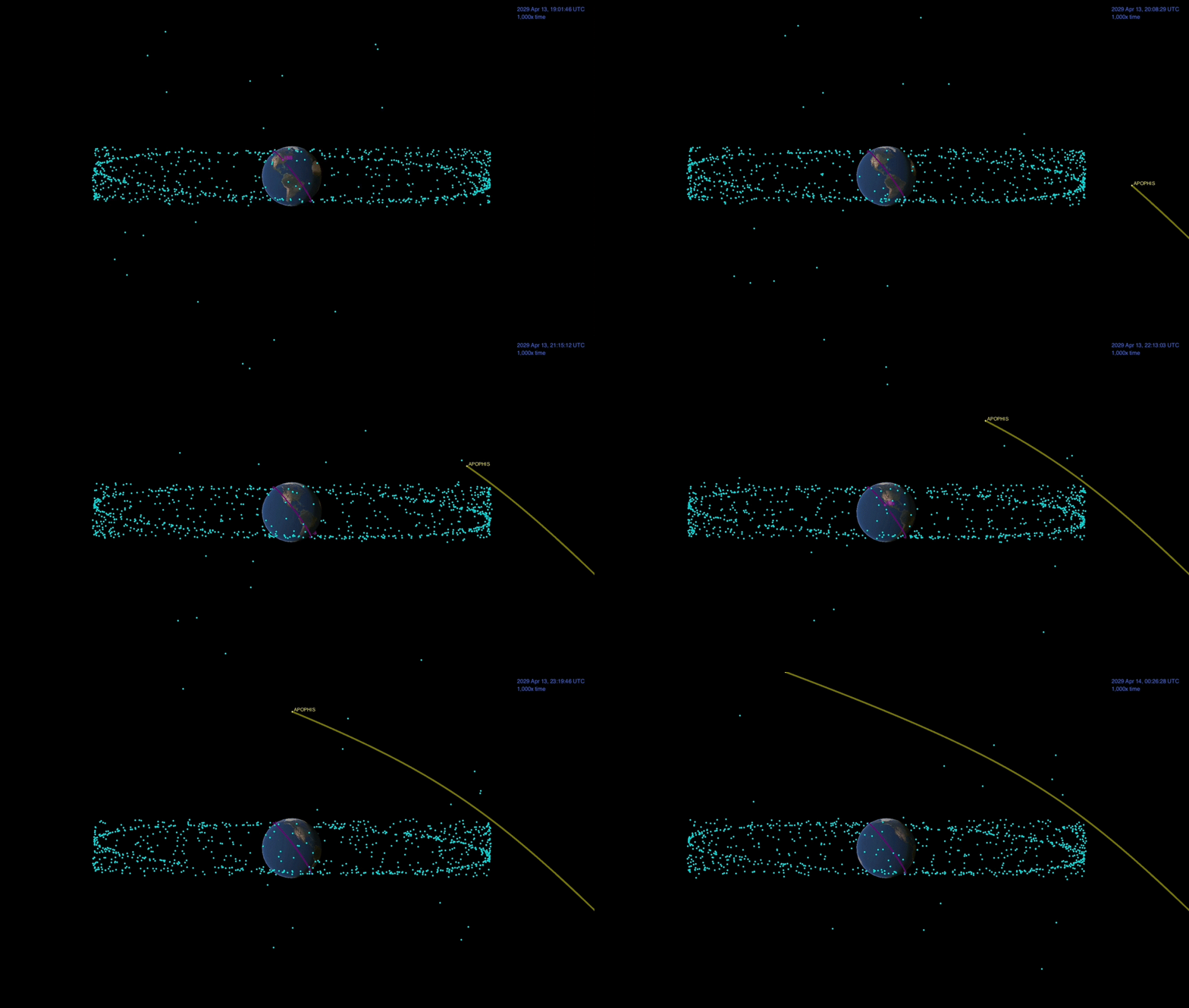
ESA says the mission is part of its planetary defense program, and findings could improve our ability to protect Earth from similar objects that are on course for impact. The number of impact craters across the Solar System shows just how chaotic a place it can be. While the chances of Earth being hit by an asteroid of significant size are slim, planetary defense remains a key concern for the space industry.
Astronomers say there’s no cause for alarm: Apophis will miss Earth, and there’s no chance of it colliding with our planet for at least the next 100 years. But it will fly close by. Around two billion people across Europe, Africa, and parts of Asia may be able to see Apophis with the naked eye under good conditions when it makes its close approach.
Astronomers say an asteroid this large comes this close to Earth just once every 5,000 to 10,000 years, making this an ideal chance to study one. Being able to calculate the trajectory of an asteroid like Apophis and predict when and where it will fly by Earth is one thing, but imagine being able to send a spacecraft to rendezvous with the space rock and follow it on its journey. That’s what Ramses will do, should everything go to plan.
“There is still so much we have yet to learn about asteroids, but, until now, we have had to travel deep into the Solar System to study them and perform experiments ourselves to interact with their surface,” says Patrick Michel, Director of Research at CNRS at Observatoire de la Côte d’Azur in Nice. “For the first time ever, nature is bringing one to us and conducting the experiment itself. All we need to do is watch as Apophis is stretched and squeezed by strong tidal forces that may trigger landslides and other disturbances and reveal new material from beneath the surface.”
Ramses needs to launch in April 2028 to ensure it can arrive at Apophis in February 2029, two months before its close approach with Earth. Permission to begin preparatory work on the mission has been granted, and the decision on whether to commit to the mission in full is due to be made at ESA’s Ministerial Council meeting in November 2025. Ramses will analyze asteroid Apophis before and after its flyby of Earth, taking note of the asteroid’s shape, surface, orbit, rotation, and orientation. It is expected to reveal how the asteroid is affected by external forces, such as the pull of Earth’s gravity, in terms of its composition, interior structure, cohesion, mass, density, and porosity.
“These are all very important properties for assessing how best to knock a hazardous asteroid off a collision course with Earth,” a statement from ESA says. “As asteroids are also time capsules formed over four billion years ago, data from Ramses will offer new scientific insights into the formation and evolution of the Solar System.”