

After years of suspicion and unanswered questions, astronomers have finally confirmed that Betelgeuse—the iconic red supergiant in Orion—has a companion star. Using cutting-edge speckle imaging with the Gemini North telescope in Hawaii, a team from NASA’s Ames Research Center captured the first high-resolution image of the elusive star, a much younger and smaller stellar neighbor orbiting closely around Betelgeuse. The finding answers long-standing questions about Betelgeuse’s mysterious six-year dimming cycle and changes how we understand the behavior of one of the most closely studied stars in our sky.
The companion star, about 1.5 times the mass of our Sun, had been theorized in earlier studies, but many believed it would never be seen. Now, thanks to imaging techniques that eliminate atmospheric distortions, astronomers have not only spotted it but also measured some of its key characteristics—including its mass and temperature. Unlike Betelgeuse, which is nearing the end of its life and is expected to go supernova soon, the companion is so young it hasn’t even begun nuclear fusion. It’s still in the earliest stages of stellar evolution, which is a stunning contrast to its massive, aging partner.
Betelgeuse itself is between 10 and 20 times the mass of the Sun and sits relatively close to Earth, making it one of the most observed stars in the night sky. Its brightness fluctuates in a 400-day cycle, but astronomers have long been puzzled by an additional dimming period that happens roughly every six years. That anomaly is now understood to be the result of gravitational interaction with its tiny companion, which disturbs surrounding cosmic dust and contributes to the irregular dimming. This is different from the well-known “Great Dimming” event of 2019–2020, which scientists believe was caused by Betelgeuse expelling a giant cloud of dust.
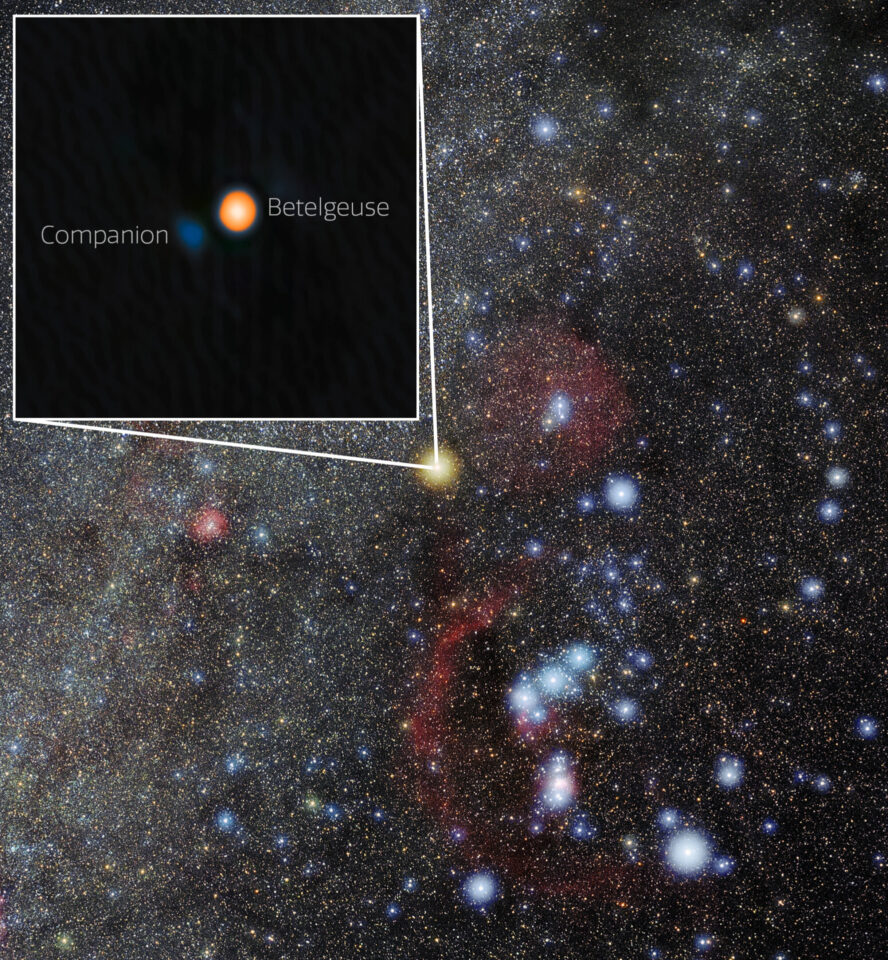
Steve Howell, who led the team behind the discovery, called it a breakthrough that opens new doors for observational astronomy. The presence of this companion not only clears up a longstanding mystery but also changes how we think about red supergiants like Betelgeuse. Though the smaller star has been spotted now, it won’t be visible for long. Betelgeuse’s intense gravity is expected to absorb it completely within the next 10,000 years—a blink in cosmic time. However, astronomers believe the companion will be at its most visible again in November 2027, when it reaches its farthest point from Betelgeuse.
This discovery doesn’t just solve a cosmic riddle—it offers a glimpse into the final moments of a giant star’s life, a chance to study close binary interactions, and a rare look at stellar evolution unfolding before our eyes. As Betelgeuse inches toward its fiery finale, we now know it’s not alone.