

Blue Origin successfully launched six passengers on a sub-orbital trip beyond the Earth’s atmosphere Thursday, marking the company’s eighth crewed spaceflight. Among the passengers were a NASA-sponsored researcher and the youngest woman ever to fly in space, as the New Shepard rocket carried the crew on a thrilling journey to the edge of space and back.
The crew included Rob Ferl, a researcher from the University of Florida; philanthropist Nicolina Elrick; adventurer Eugene Grin; Vanderbilt University cardiologist Elman Jahangir; American-Israeli entrepreneur Ephraim Rabin; and 21-year-old Karsen Kitchen, a senior at the University of North Carolina. The group blasted off from Jeff Bezos’ West Texas launch site at 9:07 a.m. EDT.
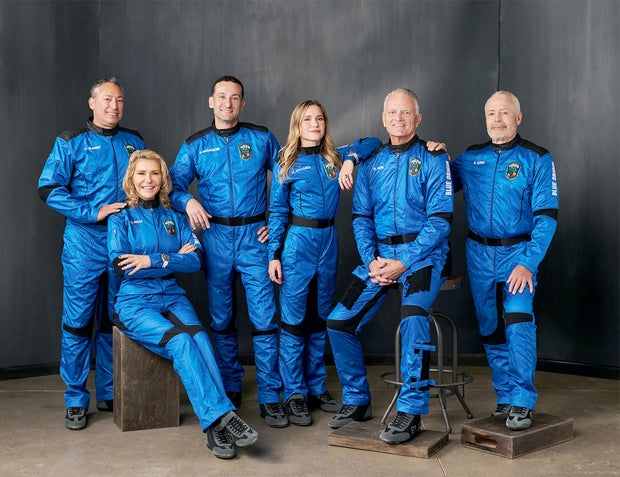
Powered by a single-stage, hydrogen-fueled rocket, the New Shepard crew capsule ascended rapidly, disappearing into a deck of clouds as it was boosted to a maximum velocity of 2,238 mph. Moments later, the rocket’s BE-3 engine shut down, signaling the start of about three minutes of weightlessness for the crew, who were treated to breathtaking views of Earth from an altitude of 345,000 feet, or approximately 65 miles above the surface.
Both NASA and the U.S. Air Force consider the 50-mile mark as the boundary of space, while the internationally recognized Kármán line sits at 62 miles. The New Shepard capsule easily passed both markers, reaching the lower limits of space before beginning its descent back to Earth.
After the capsule separated from the booster, the reusable rocket successfully landed back at the Texas launch site, touching down on a concrete pad. The crew capsule, meanwhile, took a bit longer to return, descending gently under three large parachutes for a smooth landing at 9:17 a.m. The entire journey, from liftoff to touchdown, lasted just 10 minutes and eight seconds.
As the crew exited the spacecraft, they were greeted with joyous embraces from family and friends, their faces alight with excitement. Ferl, who conducted NASA-funded research during the flight to study how genes respond to the transition to and from weightlessness, expressed his awe after the experience. “The ride was incredibly smooth; I was so impressed with the ride up,” Ferl said. “But being there, the darkness of space, there’s no way to talk about it. There’s no way to talk about how impressive space is and the Earth below.”
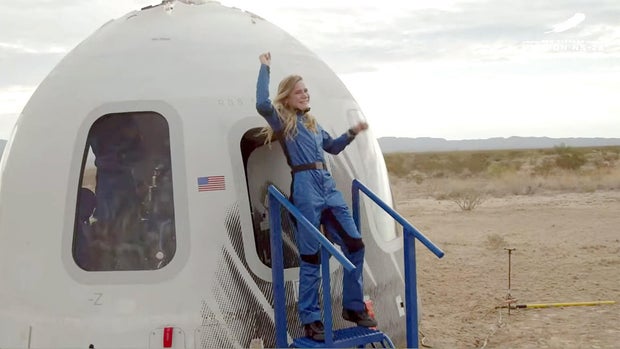
Karsen Kitchen, now the youngest woman to fly in space, was equally ecstatic. She repeatedly hugged her father, Jim Kitchen, a University of North Carolina professor who himself flew on a Blue Origin mission in 2022. “When she was a little girl, she told me definitively she was going to be an astronaut,” her father said before the launch. “It’s emotional to see someone that’s wanted to go to space and it’s actually a dream come true.”
Blue Origin continues to build on its New Shepard rocket and spacecraft for space tourism, human-tended research, and unpiloted experiments. The company is also developing the New Glenn rocket, a larger orbit-class vehicle designed to compete with SpaceX’s Falcon boosters. The first New Glenn rocket is tentatively scheduled for launch on October 13 from Cape Canaveral Space Force Station, where it will carry NASA’s ESCAPADE probes to Mars to study the interaction between the solar wind and the Martian atmosphere.