

China’s Chang’e-6 mission has marked a significant milestone in lunar exploration by successfully collecting and analyzing the first-ever samples from the Moon’s far side. Building on the achievements of its predecessors, the Chang’e-6 mission has provided unprecedented insights into the composition and geological history of the Moon’s South Pole-Aitken basin, one of the largest and oldest impact craters in the solar system.
The Chang’e-6 spacecraft, launched as part of China’s ambitious lunar exploration program, made history by landing on the Moon’s far side, a region that has remained largely unexplored due to its perpetual obscurity from Earth. In June, Chang’e-6 touched down in the South Pole-Aitken basin, a vast and ancient impact site that has long intrigued scientists for its potential to reveal the Moon’s formative years. During its mission, the spacecraft collected approximately 1,935 grams of lunar material, including both basaltic and non-basaltic samples. These materials are crucial for understanding the Moon’s geological evolution, as they provide evidence of both volcanic activity and meteorite impacts that have shaped the lunar surface over billions of years.
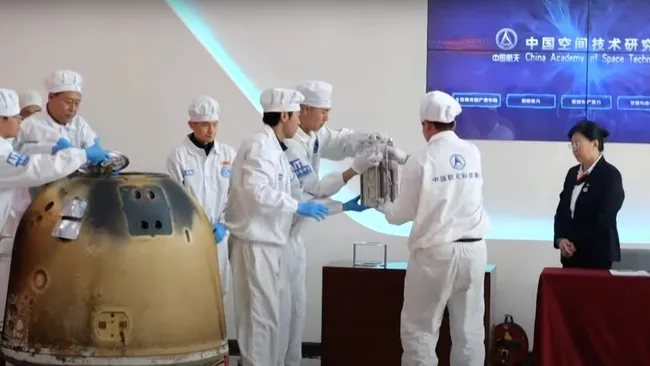
The South Pole-Aitken basin is particularly significant because it is one of the oldest and largest impact structures on the Moon, spanning over 2,500 kilometers in diameter. The samples collected by Chang’e-6 have already yielded important discoveries, indicating that this region experienced extensive volcanic activity alongside frequent meteorite bombardments. The presence of basaltic materials suggests that there were periods of volcanic eruptions that contributed to the Moon’s thermal evolution, while the non-basaltic materials point to a history of intense impact events. These findings support the theory that the Moon’s far side has a more complex and varied geological history compared to the near side, which is characterized by large maria—vast plains of solidified lava that are easily visible from Earth.

One of the most groundbreaking aspects of the Chang’e-6 mission is the confirmation of significant geological differences between the Moon’s near and far sides. Unlike the near side, where maria dominate the landscape, the far side remains rugged and devoid of these large volcanic plains. The analysis of Chang’e-6’s samples reveals a mixture of volcanic and impact-related materials, suggesting that the far side underwent different evolutionary processes. This disparity is likely due to variations in crust thickness, impact frequency, and volcanic activity between the two hemispheres. The thicker crust on the far side may have inhibited widespread volcanic eruptions, leading to a more fragmented and uneven terrain.
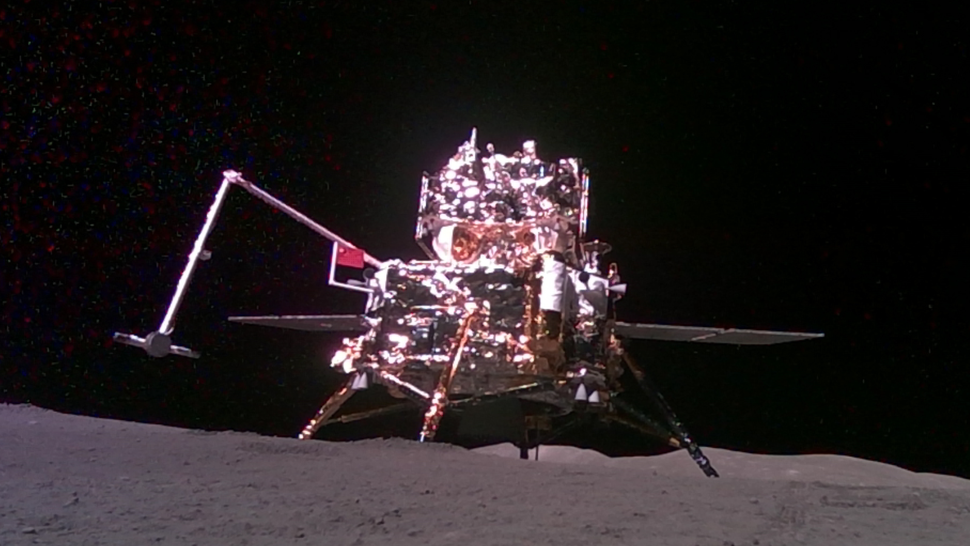
The implications of these discoveries extend beyond lunar science, offering valuable insights into the early history of the solar system. The Moon’s far side, being less affected by Earth’s gravitational pull and meteorite impacts, serves as a pristine record of ancient cosmic events. By studying the samples from the Chang’e-6 mission, scientists can gain a better understanding of the Moon’s formation, the nature of its volcanic activity, and the frequency and impact of meteorite collisions during the early stages of the solar system’s development.
Furthermore, the success of the Chang’e-6 mission underscores China’s growing capabilities in space exploration. With plans to establish a lunar research station and undertake further missions to the Moon and beyond, China is positioning itself as a major player in the global space community. The ability to land on the Moon’s far side and return with valuable scientific samples demonstrates significant advancements in China’s space technology and mission planning.
As researchers continue to analyze the data and samples brought back by Chang’e-6, the mission promises to unlock more secrets about the Moon’s distant regions. Future studies will likely explore the thermal and tectonic history of the far side, providing a more comprehensive picture of the Moon’s overall geological landscape. Additionally, the techniques and technologies developed for Chang’e-6 will pave the way for more ambitious missions, potentially extending human and robotic exploration deeper into the solar system.
In conclusion, the Chang’e-6 mission has not only achieved a historic first by collecting samples from the Moon’s far side but has also significantly advanced our understanding of the Moon’s geological history. The findings from the South Pole-Aitken basin highlight the intricate and varied processes that have shaped our celestial neighbor, offering a window into the early solar system’s dynamics. As China continues to expand its presence in space exploration, the Chang’e-6 mission stands as a testament to the nation’s commitment to uncovering the mysteries of the Moon and beyond.