

In a remarkable discovery that has captivated the paleontological community, matching sets of dinosaur footprints from the Early Cretaceous period have been unearthed on opposite sides of the Atlantic Ocean, offering profound insights into Earth’s geological past. These footprints, totaling more than 260, were found in Brazil’s Sousa Basin and Cameroon’s Koum Basin, and they provide compelling evidence of the last land connections between South America and Africa before the continents were separated by the opening of the South Atlantic Ocean nearly 120 million years ago.
The discovery of these footprints is significant not only for its geological implications but also for what it reveals about the dinosaurs that once roamed these ancient lands. The footprints, left by a variety of dinosaurs including theropods, sauropods, and ornithischians, suggest that these creatures were able to migrate freely across a land bridge that connected Africa and South America during the prehistoric era. This connection was part of the supercontinent Gondwana, which included most of the landmasses in today’s Southern Hemisphere.
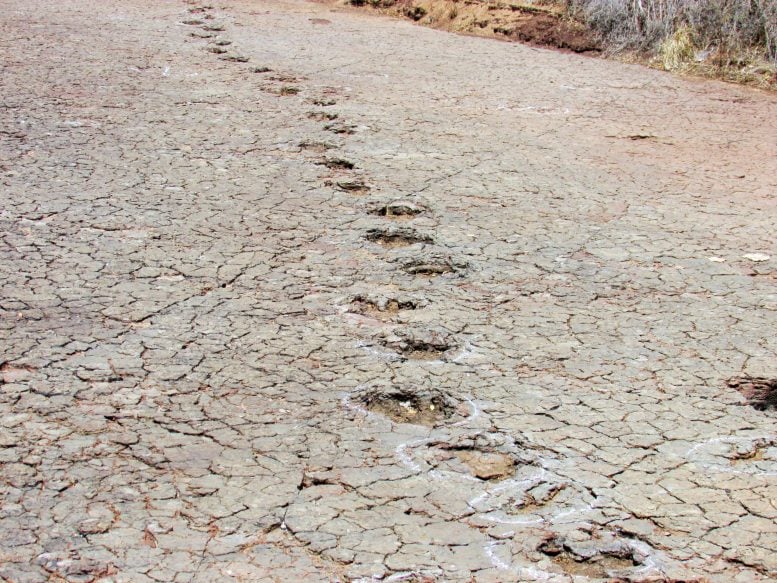
Basin preserved in floodplain deposits of Lower Cretaceous. Credit: Ismar de Souza Carvalho
Louis L. Jacobs, a paleontologist at Southern Methodist University (SMU) who led the research, highlighted the extraordinary nature of these findings. “We determined that in terms of age, these footprints were similar. In their geological and plate tectonic contexts, they were also similar. In terms of their shapes, they are almost identical,” Jacobs explained. The identical nature of the footprints on both sides of the Atlantic provides a vivid reminder of a time when Africa and South America were still connected, allowing dinosaurs to traverse the land bridge before it was submerged by the forming South Atlantic Ocean.
These footprints were preserved in mud and silt deposits along ancient rivers and lakes, creating fossilized records of dinosaur movement in regions that are now separated by more than 3,700 miles of ocean. The area where the footprints were found corresponds to a narrow land bridge that once linked northeastern Brazil with what is now Cameroon. As the Earth’s tectonic plates continued to shift, this land bridge was eventually submerged, leading to the creation of the South Atlantic Ocean and the permanent separation of the continents.
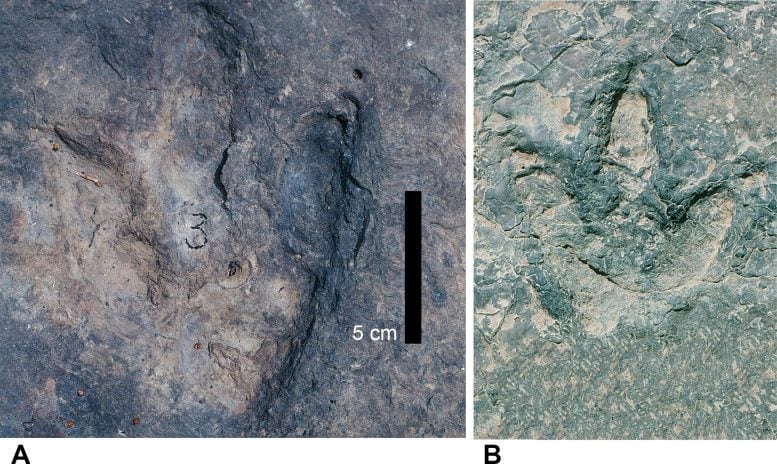
In addition to the footprints, researchers also discovered fossil pollen in the same sediment layers, helping to date the tracks to approximately 120 million years ago. These findings were made in geological formations known as half-graben basins, which were created as the Earth’s crust began to pull apart during the continental rifting process. These basins, with their layers of ancient river and lake deposits, offer a wealth of information about the environments in which these dinosaurs lived.
“These river valleys could provide specific avenues for life to travel across the continents 120 million years ago,” explained Jacobs. The rivers and lakes in these basins supported diverse ecosystems, with lush vegetation that fed herbivorous dinosaurs and other species, while muddy sediments preserved the footprints of carnivorous theropods and other creatures. The tracks are significant not only because they offer a window into the past but also because they reveal the critical role these river systems played in connecting the two landmasses.
The geological formations in which the tracks were found provide vital clues about the environment during the final days of Gondwana. As the landmasses drifted apart, magma from the Earth’s mantle rose to form new oceanic crust, eventually filling the gap with water to create the South Atlantic Ocean. The footprints found in the basins are among the last physical evidence of dinosaur movement between the continents before this vast ocean severed the connection forever.
This discovery has broader implications for our understanding of continental drift and dinosaur migration. The study, published by the New Mexico Museum of Natural History & Science, is a tribute to the late paleontologist Martin Lockley, whose pioneering work in ichnology (the study of fossilized footprints) laid the groundwork for understanding these ancient migrations. The footprints are not just marks in the ground; they are direct evidence of how plate tectonics and continental drift have shaped life on Earth.
By studying these tracks and the geological contexts in which they were found, researchers can better understand how species adapted to and navigated changing environments over time. The near-identical nature of the tracks on both continents suggests that the same species of dinosaurs roamed freely across the land bridge before being separated by the forming ocean. This finding emphasizes the significance of Gondwana’s fragmentation and how the movement of Earth’s tectonic plates led to the isolation of species on different continents, driving evolutionary changes that have resulted in the biodiversity we see today.
The discovery of these dinosaur footprints on opposite sides of the Atlantic offers a compelling glimpse into the dramatic changes that have shaped our planet’s surface over millions of years, highlighting the dynamic forces of geological and biological evolution.