

SpaceX is preparing to embark on a daring new mission called Polaris Dawn, which will push the boundaries of commercial space travel by sending an all-civilian crew on a five-day trek to the outer reaches of Earth’s orbit. The mission, set to launch from NASA’s Kennedy Space Center in Florida, aims to reach an altitude of 870 miles—placing the crew deep within the hazardous Van Allen radiation belts. If successful, Polaris Dawn will also include the first-ever commercial spacewalk, marking a significant milestone in the history of private space exploration.
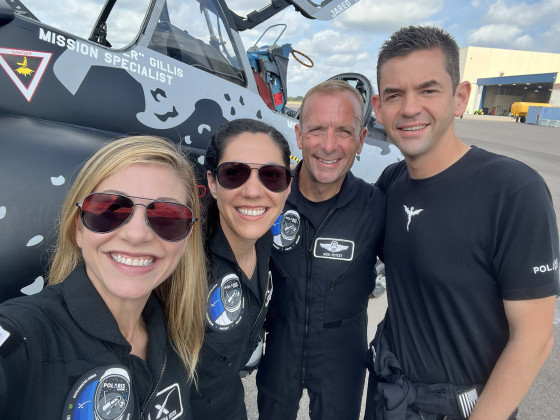
The four-person crew leading this mission is a diverse group of professionals with extensive experience in aviation and spaceflight operations. At the helm is billionaire entrepreneur Jared Isaacman, the founder of the payment processing company Shift4. Isaacman is no stranger to space; he previously commanded the Inspiration4 mission in 2021, the first all-civilian mission to orbit, which sought to demonstrate that ordinary people could train for and complete space missions. However, Polaris Dawn represents a more ambitious and technically demanding endeavor.
Joining Isaacman on this journey are Sarah Gillis and Anna Menon, two SpaceX engineers making their first trips to space. Both women have played critical roles in training NASA astronauts and supporting high-profile missions from the ground. Gillis, a lead operations engineer, has been instrumental in developing the training programs for SpaceX’s Crew Dragon missions, while Menon, who holds a master’s degree in biomedical engineering, has worked as a biomedical flight controller at NASA before joining SpaceX. Rounding out the crew is Scott “Kidd” Poteet, a former United States Air Force pilot with over 3,200 hours of jet flight experience. Poteet has been a close collaborator with Isaacman, previously serving as the mission director for Inspiration4.
The crew’s mission will not only test the limits of human endurance in space but also evaluate new space technologies developed by SpaceX. These include Extravehicular Activity (EVA) suits, which were designed in just 2 ½ years specifically for the high-risk spacewalk that two of the crew members will attempt early in the mission. The mission will also involve conducting approximately 40 scientific experiments, many focused on understanding the effects of space travel on the human body, including space adaptation syndrome—a type of severe motion sickness that affects many astronauts.
Isaacman’s vision for Polaris Dawn goes beyond the immediate goals of the mission. He sees it as part of a broader effort to advance human space exploration, aligning with SpaceX’s long-term objective of enabling humans to live and work on other planets. The Polaris Dawn mission is the first of three planned under the Polaris Program, each designed to push the boundaries of what’s possible in space. The final mission in the series is expected to be the first human spaceflight aboard SpaceX’s Starship rocket, a vehicle that is integral to NASA’s Artemis program, which aims to return humans to the moon.
The journey will not be without its risks. The Van Allen radiation belts pose significant hazards, and the crew’s reentry to Earth will involve enduring extreme temperatures as their spacecraft’s exterior heats to over 3,000 degrees Fahrenheit during descent. Despite these dangers, the crew remains committed to their mission. Poteet, echoing the confidence of his fellow crew members, stated that he has “absolutely zero reservations” about the mission, expressing full trust in the SpaceX team’s meticulous preparations.
As the Polaris Dawn mission prepares for launch, the world watches with anticipation, eager to see how this latest venture will expand the frontiers of commercial spaceflight and what it will reveal about the future of human exploration beyond Earth.