

Firefly Aerospace has successfully launched a NASA-sponsored mission carrying eight cubesats into low Earth orbit. The mission, titled “Noise of Summer,” marked the fifth flight of Firefly’s Alpha rocket and took off from California’s Vandenberg Space Force Base early Thursday morning (July 4) at 12:04 a.m. EDT (0404 GMT; 9:04 p.m. on July 3 local California time).
Initially scheduled for two days earlier, the launch faced delays due to issues with ground support equipment, leading to a scrubbed attempt on July 2 and an additional day of analysis before the final launch.
The 95-foot-tall (29-meter-tall) Alpha rocket carried eight cubesats selected through NASA’s Cubesat Launch Initiative, which aims to facilitate space access for satellites developed by U.S. colleges, universities, and nonprofit organizations. The cubesats on this mission were created by teams from the University of Arizona, the University of Kansas, the University of Maine, the University of Washington, the nonprofit Teachers in Space, and NASA’s Johnson Space Center and Ames Research Center.
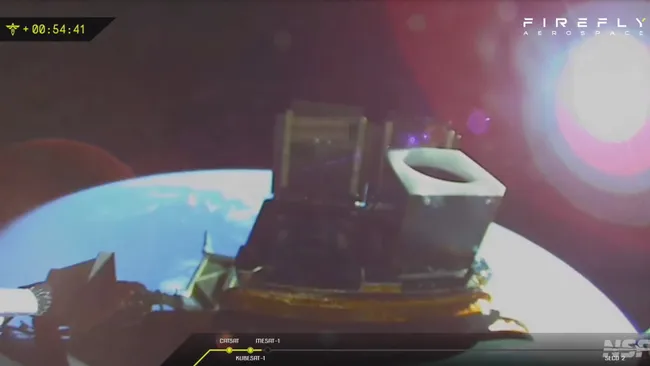
Deployment of all eight cubesats was scheduled to occur within 55 minutes after launch. About an hour post-liftoff, Firefly confirmed the successful deployment of seven cubesats, with the status of the University of Arizona’s CatSat still being verified.
“Noise of Summer” was also a demonstration of Firefly’s rapid response capabilities. The company highlighted that the mission was conducted as a responsive space operation, which involved transporting the payload fairing to the launch pad and integrating it with the Alpha rocket just hours before the scheduled liftoff, a process that typically takes weeks.
Firefly Aerospace has built a reputation for such quick-turnaround launches. In September 2023, the company launched the “Victus Nox” mission for the U.S. Space Force just 27 hours after receiving the official order, setting a record for the fastest turnaround for a national security mission.
The Alpha rocket made its debut in September 2021 with a test flight that failed shortly after liftoff. The second mission in October 2022 was a partial success, delivering seven satellites to orbit, though they were deployed too low. The third mission, “Victus Nox,” was a complete success, while the fourth mission in December 2022 saw a mixed outcome. Although the rocket delivered its payload, an electronically steerable antenna developed by Lockheed Martin, it did not reach the target orbit. Nonetheless, Lockheed Martin managed to achieve its primary mission objectives.
The successful launch of “Noise of Summer” reaffirms Firefly Aerospace’s capability to deliver responsive and reliable space missions. As the company continues to refine its technology and processes, it stands to play a significant role in the growing space industry, particularly in facilitating rapid and efficient access to space for various stakeholders.