

Key Takeaways
- Hubble is now vulnerable to bright satellite streaks crossing its long-exposure images.
- A NASA-led study estimates that future megaconstellations could affect up to 40% of Hubble images.
- As of 2023, about 2.7% of Hubble exposures already show at least one satellite trail.
- Streaks can erase faint cosmic signals, disrupt asteroid searches, and degrade scientific data.
- Mitigations include AI-based image cleaning, improved observation scheduling, and darker satellite coatings.
The Hubble Space Telescope, once immune to light pollution affecting ground-based observatories, is now facing a new and growing threat: reflected sunlight from artificial satellites. As companies deploy thousands of spacecraft into low-Earth orbit, the risk of satellites crossing Hubble’s field of view during an exposure is increasing sharply.
The problem appears when a satellite, illuminated by the Sun, crosses Hubble’s line of sight. Because Hubble relies on long-exposure imaging to detect faint and distant galaxies, nebulae, and other cosmic phenomena, even a fast-moving satellite shows up as a bright, thin streak across the picture. These trails can hide or distort delicate details that astronomers are trying to measure.
Historically, contamination of astronomical images was a problem limited to Earth-based telescopes. But the explosion of large satellite constellations in low orbit has changed that. A NASA-led study found that if future constellations reach their projected numbers of over 500,000 satellites, as many as 4 in 10 Hubble images could contain at least one visible satellite streak.
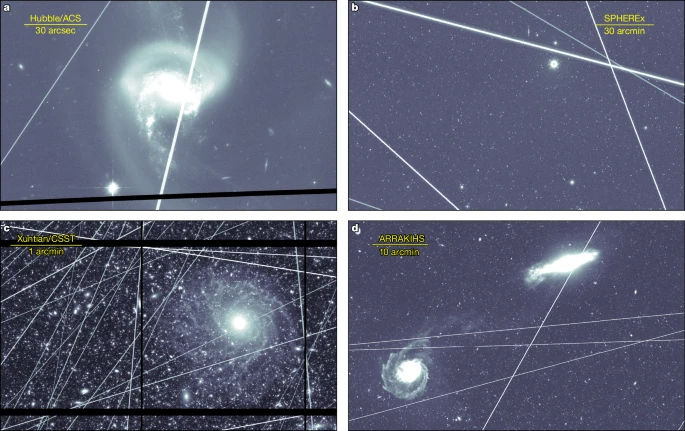
For now, the contamination level is small but rising. As of 2023, around 2.7% of Hubble’s images show signs of satellite interference. The concern is not just visual clutter. These streaks can block the faint signatures of distant galaxies or mimic fast-moving near-Earth asteroids, disrupting scientific surveys and making it harder to detect time-critical events like supernovae or rapidly changing stars.
Astronomers and satellite companies are exploring several strategies to reduce the impact. On the data side, teams are developing specialized algorithms that can automatically detect and remove satellite streaks. Some methods use AI or mathematical models such as the Radon Transform to mask or repair affected pixels without losing valuable scientific information.
Observation planning can also help, although the benefit is shrinking. With the number of satellites rising into the tens of thousands, predicting clear windows for Hubble is becoming increasingly difficult. There simply are not enough satellite-free moments in the night sky anymore.
Satellite design changes may provide longer-term relief. Operators are being encouraged to adopt anti-reflective coatings, sunshades, or lower orbital altitudes. SpaceX, for example, has experimented with darker coatings like DarkSat and visors like VisorSat to reduce brightness. But Hubble orbits at roughly 538 kilometers, meaning that any satellites in higher shells are especially likely to cross its view.
While current mitigation tools keep the issue manageable, the long-term outlook is concerning. If megaconstellations continue to expand at the projected pace, both Hubble and future wide-field space telescopes in low-Earth orbit could face significant challenges in preserving clean, unobstructed views of the universe.