

Key Takeaways
- The Galaxy Z TriFold features three folding sections that create a 10-inch, 2160 × 1584 OLED display.
- A 6.5-inch 1080p cover screen lets users operate it like a regular phone when folded.
- Samsung refined its Armor FlexHinge system with two differently sized hinges to support the tri-panel design.
- The device weighs 309 g, making it one of Samsung’s heaviest phones.
- It supports Samsung DeX, triple-app multitasking, and runs on the Snapdragon 8 Elite with 16 GB RAM and 512 GB storage.
- Launches in Korea on December 12 at KRW 3,590,400 (about $2,500 USD), with a US release planned for early 2026.
Samsung has taken foldables to the next level with the Galaxy Z TriFold, a smartphone that unfolds into a full 10-inch tablet. While Samsung already leads the conventional foldable market with its Z Flip and Z Fold series, the TriFold introduces a new category altogether by using three connected display panels instead of two.
To make the design possible, Samsung redesigned its Armor FlexHinge system. The phone uses two hinges of slightly different sizes because each of the three screen segments has a different thickness. The center panel is the thickest at 4.2 mm, while the others are slightly thinner. Together, they fold tightly into a surprisingly compact footprint for a tri-fold device.
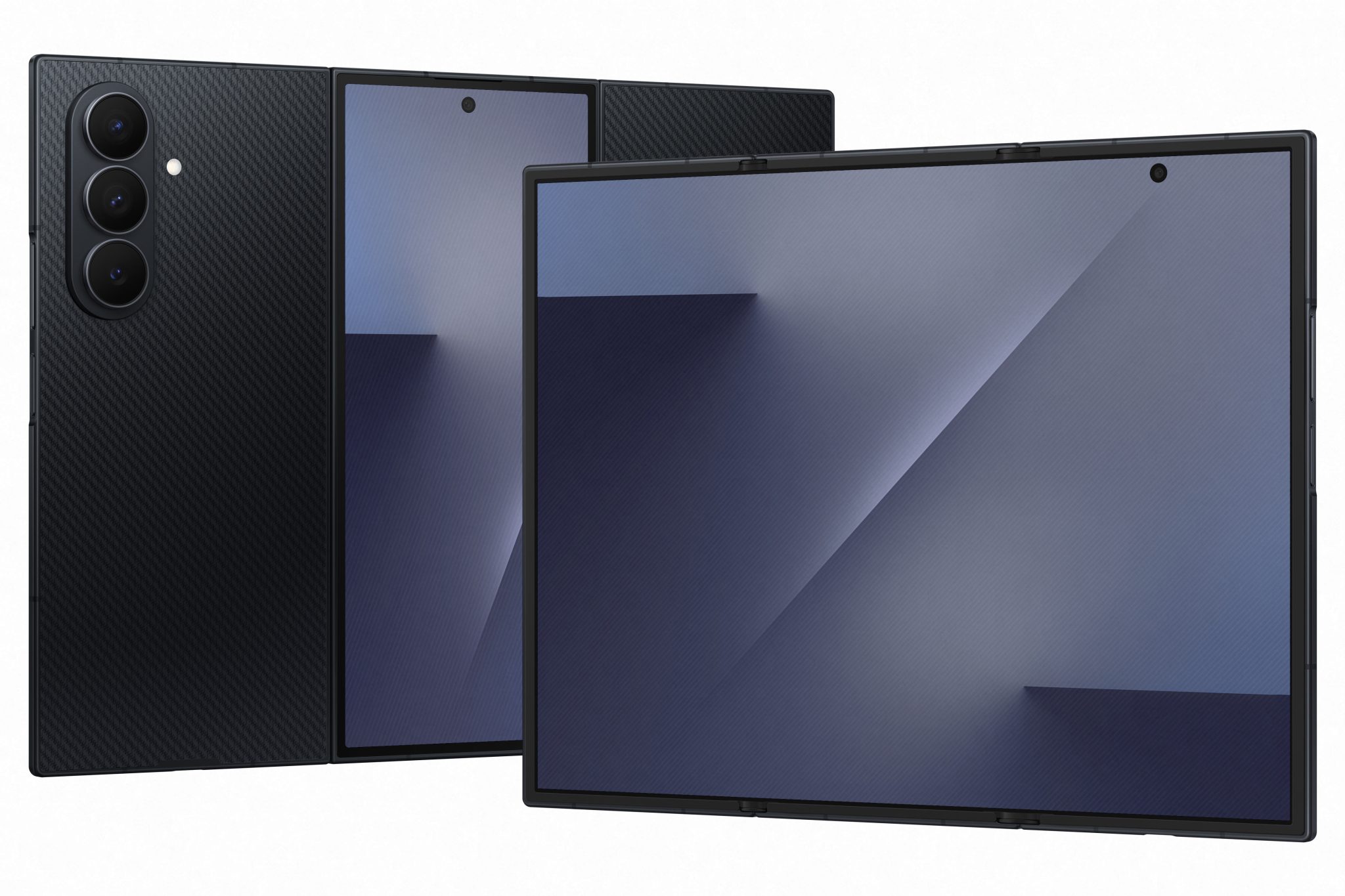
Tri-fold phones from other brands, like Huawei’s Mate XT, have generated buzz online but are not available in Western markets. Samsung’s TriFold takes a different approach. Instead of using a Z-shaped fold where part of the main screen becomes the cover display, Samsung designed the left and right panels to fold inward behind a separate outer display. The company says it tested the hinges extensively to ensure they hold up under years of everyday use.
Even so, this device definitely pushes the boundaries of what most people consider pocketable. When folded, the phone measures 12.9 mm thick, which is noticeably bulkier than the Galaxy Z Fold 7’s 8.9 mm profile, but still comparable to earlier Fold generations. The 6.5-inch cover screen offers a familiar smartphone experience before you open the device into tablet mode.
Inside, the TriFold reveals its standout feature: a 10-inch foldable OLED panel with a smooth 120 Hz refresh rate. The larger screen supports up to three apps side-by-side in portrait mode and runs the full version of Samsung DeX, giving users a desktop-like workspace without needing an external monitor.
Powering all of this is a 5,600 mAh triple-cell battery, only slightly larger than typical smartphone batteries. With a screen this large, battery life may be a concern for heavy multitaskers. Internally, the device mirrors the Galaxy Z Fold 7, running the Snapdragon 8 Elite chipset, 16 GB of RAM, and 512 GB of storage. The camera system also stays familiar, featuring a 200 MP main sensor, a 12 MP ultrawide, and a 10 MP 3× telephoto lens.
Samsung will launch the Galaxy Z TriFold in South Korea on December 12, with additional Asian markets following shortly after. A US release is planned for the first quarter of 2026. Pricing has not been confirmed for the American market, but the Korean price of KRW 3,590,400 is just under $2,500, which is about $500 more than the Galaxy Z Fold 7.
For consumers willing to pay a premium for cutting-edge foldable tech, the Galaxy Z TriFold will likely be one of the most eye-catching devices of 2026.

Your First 10 AI Skills
10 practical AI skills, copy-paste prompts and a 7-day plan to start using AI with confidence.
Download the guide →