

Key Takeaways
- Helical Fusion completed the world’s first performance test of an HTS coil for commercial fusion reactors.
- The coil maintained a stable superconducting current at 40 kA under a 7-tesla magnetic field at 15 K (-258°C).
- The breakthrough paves the way for the Helix HARUKA demonstration reactor and future Helix KANATA pilot plant.
- Japan’s government awarded the company a ¥2 billion ($13 million) SBIR grant—the largest of its kind for fusion energy.
- Unlike tokamak designs, Helical Fusion’s stellarator-based system allows continuous plasma confinement for stable, long-term power generation.
Japanese startup Helical Fusion has taken a significant step toward realizing commercial nuclear fusion, announcing the world’s first successful test of a high-temperature superconducting (HTS) coil engineered for fusion reactors. The breakthrough, revealed on Monday, demonstrates Japan’s growing role in the international push to achieve limitless clean energy through fusion.
The test—conducted at the National Institute for Fusion Science (NIFS)—validated stable superconducting current flow of 40 kiloamperes (kA) under a 7-tesla magnetic field at 15 K (-258°C). These extreme conditions replicate the powerful magnetic environment inside a fusion reactor, where plasma must be contained at temperatures exceeding 100 million degrees Celsius.
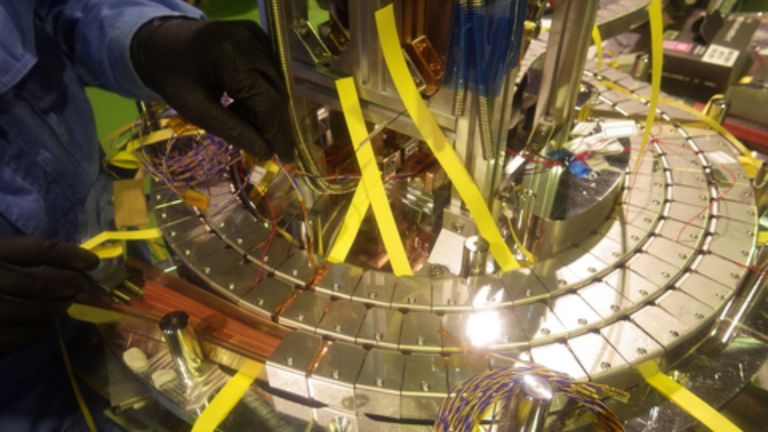
“This means that the possibility of achieving fusion power generation ahead of the rest of the world has been demonstrated,” said Takaya Taguchi, CEO of Helical Fusion. The achievement allows the company to begin manufacturing its Helix HARUKA integrated demonstration device, designed to prove continuous, steady-state fusion reactions—a crucial step toward commercial viability.
Helical Fusion’s success comes as Japan’s new Prime Minister Sanae Takaichi renews national focus on nuclear fusion as a strategic energy priority. Takaichi, who has long advocated fusion R&D, is expected to increase public investment in the sector. Helical Fusion’s project already received a ¥2 billion ($13 million) SBIR Phase 3 grant, the largest awarded to a Japanese fusion startup.
While the U.S. and China have committed roughly $66 billion to fusion research over five years, Japan’s total investment remains around ¥100 billion ($660 million). Taguchi emphasized that this funding gap presents an opportunity for Japan to scale up efforts under the new administration’s science and technology strategy.
What sets Helical Fusion apart is its use of the helical stellarator design, a magnetic confinement approach refined over six decades by Japanese researchers. Unlike tokamaks or laser-based systems, stellarators naturally stabilize plasma without the need for pulsed operation, enabling continuous, steady-state power generation—a key requirement for practical fusion energy.
The company plans to validate its core technologies by the late 2020s and to demonstrate steady-state power generation with its Helix KANATA pilot plant in the 2030s. If successful, Helical Fusion could become the first among roughly 50 global fusion startups to achieve net energy gain and routine operation.
With $9.7 billion in global fusion investment—including $2.6 billion raised in the past year—the momentum toward clean, sustainable energy is accelerating. Helical Fusion’s achievement not only underscores Japan’s engineering prowess but also represents a tangible step closer to what many call the “holy grail” of energy: practical, continuous nuclear fusion power.