

In a significant update to Windows 11, Microsoft is finally lifting the longstanding 32GB size limit on FAT32 partitions, a restriction that has been in place for nearly 30 years. This change is part of the latest Windows 11 Canary test build and represents a notable shift in how the operating system handles disk formatting, bringing long-overdue flexibility to users working with FAT32.
The FAT32 file system, originally introduced with Windows 95, has supported volumes of up to 2TB for decades. However, an arbitrary 32GB limit was imposed by Microsoft when formatting drives, a constraint that has frustrated users for years. This limit, initially set during the development of Windows 95, was implemented by former Windows developer Dave Plummer. Earlier this year, Plummer revealed that the decision to cap FAT32 partitions at 32GB was largely arbitrary, made quickly during the development process, and has remained unchanged since.
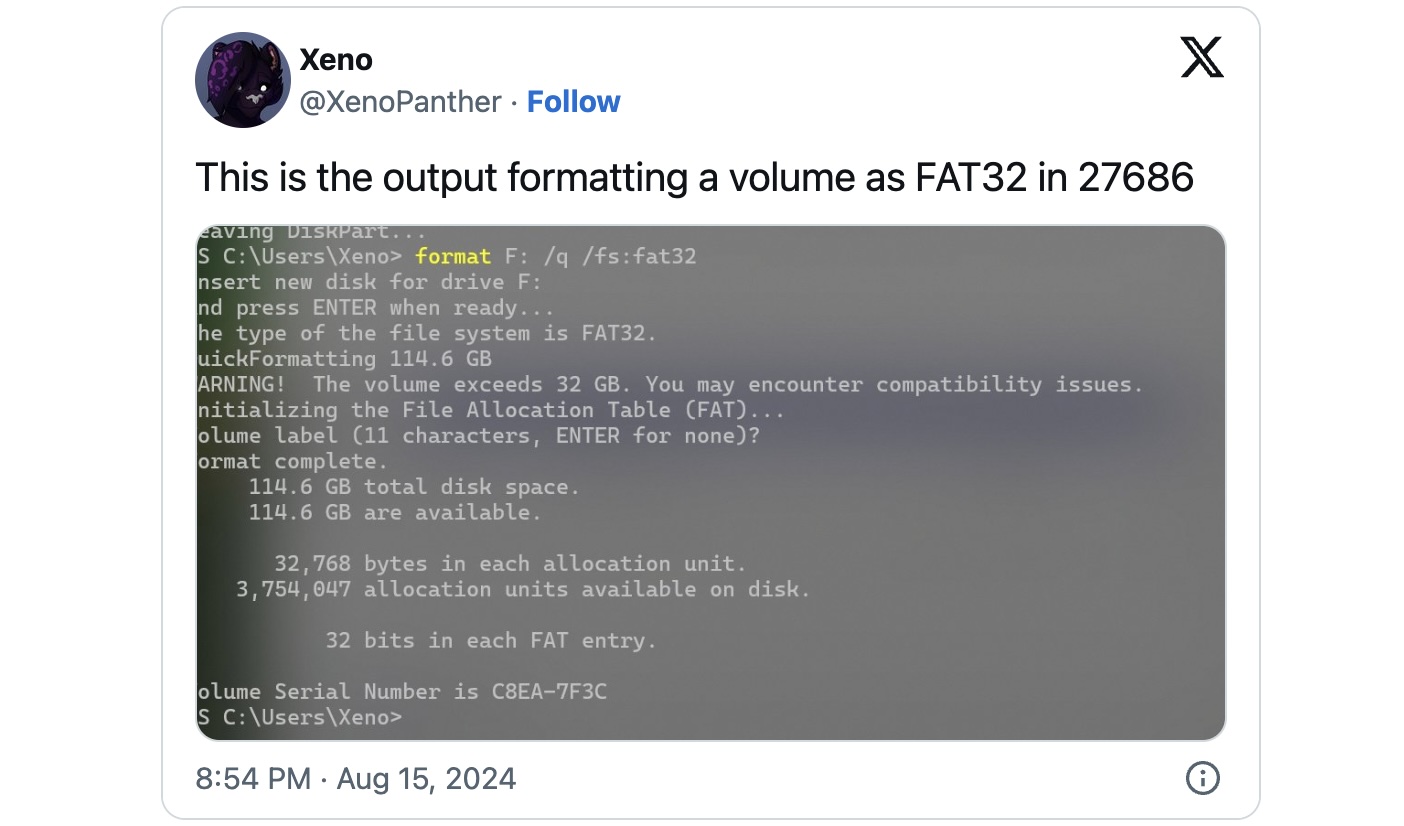
In a blog post on Thursday, the Windows team announced the removal of this limit, stating, “When formatting disks from the command line using the format command, we’ve increased the FAT32 size limit from 32GB to 2TB.” This update means that users can now create FAT32 partitions up to the 2TB limit directly within Windows, without needing third-party tools. However, it’s important to note that this change currently only applies to the command line format command. The format dialog box, accessible through the Windows GUI, still retains the 32GB limit, although many are hoping that Microsoft will update this feature in future builds of Windows 11.
The original 32GB limit was not based on any technical limitation of FAT32 itself but was instead related to concerns about “cluster slack”—the wasted space within clusters on a disk. Plummer explained that the decision was made quickly and was never revisited, leading to it becoming a de facto standard within Windows for decades. While Windows has always been capable of reading larger FAT32 partitions, users were previously unable to create them within the operating system without using external tools.
This update is a welcome change for users who still rely on FAT32, particularly for legacy devices that require this file system, such as older USB drives or SD cards. FAT32, while largely superseded by more modern file systems like exFAT and NTFS, remains in use due to its broad compatibility with various devices. However, despite the extension of the partition size limit, FAT32 still has a 4GB file size limit, which can be a significant drawback for users dealing with larger files.
The decision to remove the partition size limit in Windows 11 reflects Microsoft’s recognition of the need to modernize certain legacy features that have not kept pace with advancements in hardware and software. It also suggests a willingness to address long-standing user frustrations, even for features that may seem outdated by today’s standards.
As the change is currently limited to the command line, it remains to be seen whether Microsoft will extend this update to the more commonly used format dialog box in the graphical user interface (GUI) of Windows 11. If they do, it will further simplify the process for users who need to format large FAT32 partitions, making it accessible to a broader audience without requiring command line knowledge.
In summary, Microsoft’s removal of the FAT32 partition size limit is a significant, if belated, improvement to Windows 11. It eliminates a frustrating restriction that has persisted for decades, offering greater flexibility for users who still rely on FAT32 for certain applications. This update is a reminder of the importance of revisiting and updating legacy systems, even as technology continues to advance.

Your First 10 AI Skills
10 practical AI skills, copy-paste prompts and a 7-day plan to start using AI with confidence.
Download the guide →