

NASA has cancelled its VIPER moon rover program due to escalating costs. VIPER, which stands for Volatiles Investigating Polar Exploration Rover, was a robotic mission designed to land near the moon’s south pole and spend 100 days scouting for lunar ice deposits. Initially slated to launch in 2025 aboard an Astrobotic Griffin lander as part of NASA’s Commercial Lunar Payload Services initiative (CLPS), the VIPER mission will now be scrapped or potentially sold to industry.
The decision to terminate the VIPER mission was announced today (July 17) during a teleconference. By cancelling the program, NASA expects to save an additional $84 million in development costs. The agency has already spent about $450 million on the program, not including launch expenses.
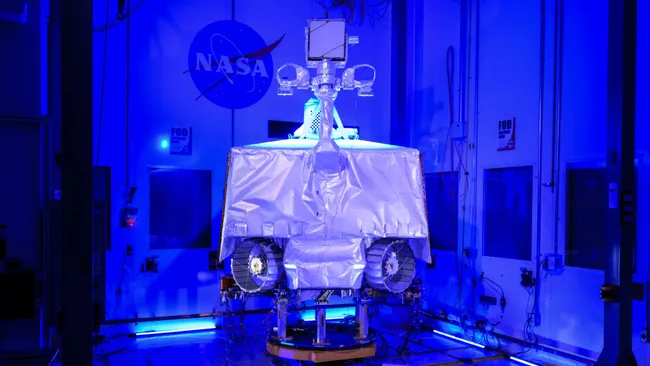
Despite the cancellation, NASA leadership emphasized that the decision was driven solely by budgetary constraints, not by the performance of the VIPER team. “We were very confident in the VIPER team. This really gets down to cost and a very constrained budget environment in the United States,” said Joel Kearns, deputy associate administrator for exploration at NASA headquarters in Washington, during the teleconference.
Nicola Fox, associate administrator of NASA’s Science Mission Directorate, echoed this sentiment: “First and most important, this is in no way a reflection on the quality of the work from the mission team that are working to build this rover. They have worked diligently, including through the pandemic, to be able to build this rover to look for water on the moon. This is a very tough decision, but it is a decision based on budgetary concerns in a very constrained budget environment.”
At the time of its cancellation, the car-sized VIPER was fully assembled and undergoing environmental testing to ensure it could withstand the physical stresses of launch and the harsh conditions of space. NASA is now looking to “potentially de-integrate and reuse VIPER scientific instruments and components for future moon missions,” Kearns said. However, NASA will first consult with both U.S. and international industry partners to gauge interest in using the rover as-is.
Despite the termination of the VIPER program, NASA remains confident that its scientific objectives can be achieved through future lunar exploration initiatives. For example, the upcoming Lunar Terrain Vehicle, designed to carry astronauts on the moon, could also be operated remotely to explore permanently shadowed regions near the lunar south pole in search of ice. Other lunar landers might also deploy instruments similar to those planned for VIPER to these areas. “We’re looking at the possibility for being able to send CLPS landers either into permanently shadowed regions, or to have CLPS landers provide some type of mobility that would get the instruments in the permanently shadowed regions,” Kearns explained.
NASA’s fiscal year 2025 budget has forced agency leadership to make difficult decisions regarding many ambitious science programs. Funding for NASA’s science programs as a whole was reduced by $1 billion for 2025, according to Fox. This reduction is compelling NASA’s Science Mission Directorate to make some “pretty tough choices.”
Other programs facing similar budgetary challenges could have significant impacts on NASA’s science and astronomy missions. For instance, the budget for the Chandra X-ray telescope has been significantly cut, falling from $41.1 million in 2025 to only $5.2 million in 2029. Additionally, the ambitious Mars Sample Return program is now seeking alternative operational concepts after its cost exceeded $11 billion, drawing Congressional scrutiny.