

NASA is set to embark on a groundbreaking mission aimed at uncovering the mysteries of one of the Solar System’s most intriguing moons. On October 10, the space agency will launch the Europa Clipper, a major endeavor designed to explore Jupiter’s largest moon, Europa, in search of potential habitats that could support alien life.
Europa Clipper represents the largest planetary exploration spacecraft ever built by NASA. When its solar sails are fully deployed, the spacecraft spans as wide as a basketball court and boasts a mass of approximately 6,000 kilograms—the equivalent of a large African elephant. This ambitious mission underscores NASA’s commitment to advancing our understanding of the icy worlds that lie beyond Neptune in the Kuiper Belt, a region teeming with millions of frozen bodies.
For years, Mars has been the primary focus of scientists searching for extraterrestrial life within our Solar System. Positioned in the habitable zone, Mars presents certain advantages, such as relative proximity to Earth. However, its harsh conditions, including a thin atmosphere and high radiation levels, make it a challenging environment for sustaining life. In contrast, moons like Europa offer intriguing possibilities due to the presence of liquid water beneath their icy surfaces—a critical ingredient for life as we know it.
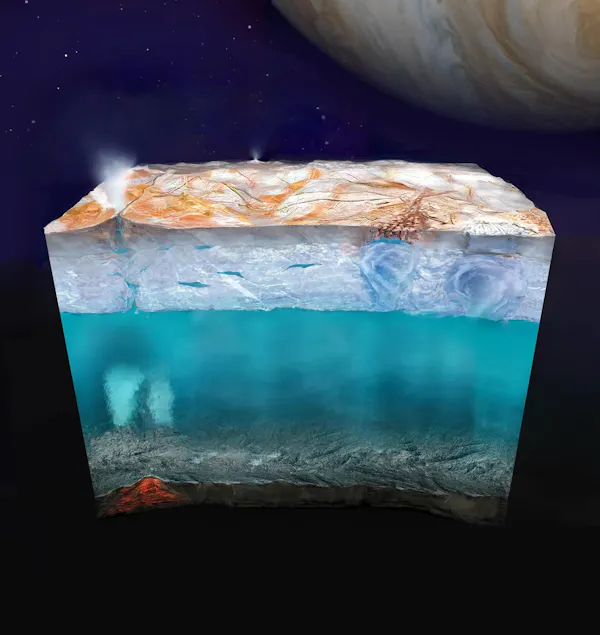
Water serves as a universal solvent, facilitating the chemical reactions necessary for life on Earth. While the potential for life forms based on alternative solvents like methane or carbon dioxide remains speculative, the presence of liquid water makes Europa a prime candidate in the search for extraterrestrial life. The gravitational pull exerted by Jupiter creates significant tidal forces on Europa, generating heat that keeps its subsurface ocean from freezing entirely.
Despite being known for over four centuries, Europa’s hidden ocean remained elusive until recent advancements in observational technology. The New Horizons spacecraft, which flew by Europa in 2015, provided valuable insights by revealing a surface dominated by water ice and ammonia, hinting at the possibility of an underlying ocean. However, definitive evidence of liquid water remained out of reach. Enter the James Webb Space Telescope and the forthcoming Europa Clipper mission, which together are poised to shed light on this enigmatic moon.
The Europa Clipper mission is equipped with nine sophisticated scientific instruments designed to conduct a comprehensive analysis of Europa’s surface and subsurface. These include a wide-angle camera for studying geological activity, a thermal imaging system to detect warmer regions on the surface, and a spectrometer to analyze the chemical composition of gases and surface materials. Additionally, the spacecraft will carry tools to map Europa’s terrain, measure the depth and salinity of its ocean, and assess the thickness of its ice shell.
One of the mission’s most exciting components is the mass spectrometer, which will analyze gases emitted from Europa’s surface plumes, if present. By examining the material ejected from these plumes, scientists hope to gain insights into the composition of Europa’s subsurface ocean without having to drill through the thick ice layer. Furthermore, a dust analyzer will study particles ejected by meteorite impacts or potential plume activity, providing additional data on the moon’s environment.
Europa Clipper’s journey to Jupiter will take over five years, traversing the vast distances of space to reach its destination. Once there, the spacecraft will perform multiple flybys of Europa, gathering data to identify regions that may harbor conditions suitable for life. While Europa Clipper is not designed to detect life directly, its findings will lay the groundwork for future missions aimed at exploring the moon’s potential habitability in greater detail.
The significance of Europa Clipper extends beyond the quest for alien life. Understanding Europa’s geology and hydrology will offer invaluable insights into the processes that shape icy moons and their oceans. These insights, in turn, can inform our broader understanding of planetary formation and the potential for life in other parts of the universe.
As NASA prepares for the launch of Europa Clipper, the mission symbolizes a pivotal moment in space exploration. By targeting one of the most promising locations for extraterrestrial life, NASA continues to push the boundaries of our knowledge and inspire future generations of scientists and explorers. The Europa Clipper mission not only aims to answer fundamental questions about life beyond Earth but also exemplifies humanity’s enduring curiosity and determination to explore the unknown.
In conclusion, the upcoming launch of the Europa Clipper mission marks a significant milestone in the search for habitable environments within our Solar System. With its advanced suite of scientific instruments and ambitious goals, Europa Clipper is poised to unlock the secrets of Jupiter’s moon Europa, potentially paving the way for the discovery of life beyond our planet. As the spacecraft hurtles through space towards its icy target, the scientific community and space enthusiasts alike eagerly await the revelations that lie ahead.