

NASA’s pioneering solar sail mission is finally flying after overcoming an initial deployment glitch that had threatened to halt its progress. The mission, which aims to test a new form of space travel by harnessing the energy of sunlight, successfully deployed its solar sail system on the second attempt, marking a significant milestone for this experimental technology.
The Advanced Composite Solar Sail System, designed to propel itself through space using photons from the Sun, experienced a setback shortly after its launch in April. During the initial deployment phase, the sail became stuck when an onboard power monitor detected higher-than-expected motor currents, causing the unfurling process to be paused. Despite this challenge, NASA’s mission teams were undeterred and made a successful second attempt, fully deploying the sail on Thursday at 1:33 p.m. ET.
The solar sail, now fully extended, covers an area of 860 square feet (80 square meters), roughly half the size of a tennis court. This large surface area is crucial for generating sufficient thrust from sunlight, allowing the spacecraft to gradually gain altitude and overcome atmospheric drag as it orbits Earth at approximately twice the altitude of the International Space Station.
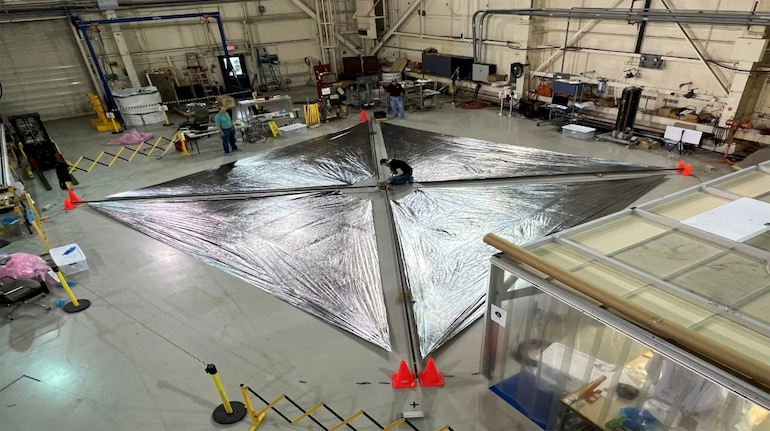
With the sail deployed, the spacecraft is now ready to begin its test phase, where NASA engineers will conduct various maneuvers to evaluate its performance. Over the next few weeks, the mission will focus on raising and lowering the spacecraft’s orbit using only the pressure of sunlight on the sail. This initial flight phase is expected to last for about two months, during which NASA hopes to gather valuable data that could inform the design and operation of future solar sail-equipped missions.
The mission also serves as a testbed for new materials and deployable structures, including innovative composite booms made from a polymer material. These booms are lightweight, yet stiff and resistant to bending and warping under different temperatures, making them ideal for supporting the solar sail in space. The booms work similarly to those on a sailboat, but instead of catching the wind, they capture the propulsive force of sunlight.
NASA’s solar sail mission represents a potential breakthrough in low-cost space travel, offering a method of propulsion that doesn’t rely on traditional fuel. By harnessing the continuous stream of photons from the Sun, solar sails could provide a sustainable and efficient way to reach various destinations across the solar system. However, the technology still faces challenges, particularly regarding the durability of the materials and spacecraft electronics over extended periods in space.
As the spacecraft embarks on its journey, equipped with four cameras that captured panoramic views of the deployment process, NASA plans to release these images to the public on September 4. The mission’s success could pave the way for future exploration missions that utilize solar sails, potentially expanding humanity’s reach into the cosmos.