

Key Takeaways
- Aalto University scientists created Parallel Optical Matrix-Matrix Multiplication (POMMM), a new way to run AI math using light.
- The method completes full tensor and matrix operations in a single pass of coherent light.
- POMMM reduces the need for repeated light propagation, a key limitation in earlier optical computing methods.
- The approach could lead to AI hardware that is significantly faster and much more energy efficient.
- Lead author Dr. Yufeng Zhang says the process works like inspecting and sorting all parcels instantly instead of machine by machine.
Researchers at Aalto University have announced an important step forward in optical computing, showing that light can be used to handle the heavy mathematical operations behind modern AI systems. The study, published on November 14 in Nature Photonics, introduces a new technique that could dramatically speed up how neural networks process information.
The method is called Parallel Optical Matrix-Matrix Multiplication, or POMMM. Matrix multiplication is the backbone of nearly every AI model, from image recognition to large language models. Today these operations rely on electricity flowing through silicon chips, which creates heat, consumes huge amounts of power, and slows down as AI systems scale.
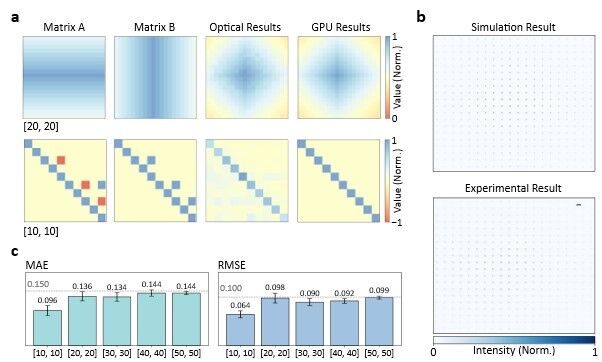
POMMM takes a completely different approach. Rather than passing light through several optical stages, as older optical computing methods required, the new system performs the entire multiplication all at once. When a beam of coherent light passes through the setup, all the inputs are connected to their correct outputs instantly.
Dr. Yufeng Zhang, the study’s lead author, explained it with a simple analogy.
He said it is like being a customs officer who normally has to run every parcel through several different inspection machines before sending them to the right bins. With POMMM, all the parcels and all the machines are combined into one operation. The light acts as a set of “optical hooks” that match each piece of information to its destination in a single step.
This instant, parallel operation could allow AI systems to run far faster while using a fraction of the energy required today. Because the system relies on light, it avoids the heat and electrical resistance that limit traditional chips.
While the technology is still in its early stages, the researchers believe POMMM could open the door to a new generation of optical AI processors designed for high-speed, low-power computation. As AI models grow larger and more demanding, innovations like this may be key to making them sustainable in the long term.

Your First 10 AI Skills
10 practical AI skills, copy-paste prompts and a 7-day plan to start using AI with confidence.
Download the guide →