

SpaceX is poised to make history next week with the launch of Polaris Dawn, an ambitious mission featuring the first spacewalk conducted entirely by a civilian crew. The mission is scheduled to lift off from NASA’s Kennedy Space Center in Florida between 3:30 a.m. and 7 a.m. ET on Monday, marking a significant milestone in commercial space exploration.
Leading the mission is billionaire entrepreneur Jared Isaacman, the founder and CEO of the payment processing company Shift4. Isaacman is no stranger to space; he previously commanded the first all-civilian SpaceX mission to orbit in 2021. Polaris Dawn is the first of three planned spaceflights that Isaacman is funding and organizing in partnership with SpaceX, collectively known as the Polaris program.
Joining Isaacman on this pioneering mission are three other crew members: Scott “Kidd” Poteet, a retired Air Force lieutenant colonel who will serve as the pilot, and SpaceX engineers Sarah Gillis and Anna Menon. Together, they will embark on a five-day journey aboard a SpaceX Crew Dragon capsule, launched into space atop a Falcon 9 rocket. The mission’s trajectory will take them to an orbital altitude more than three times higher than the International Space Station (ISS), reaching heights not achieved by humans since the Apollo moon missions in 1972.
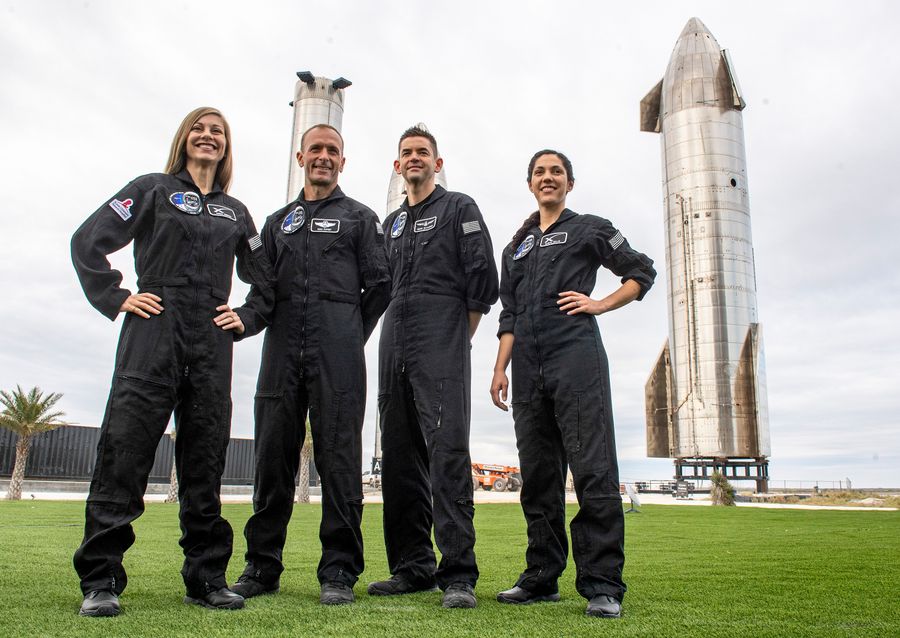
Jonathan Newton/The Washington Post/Getty Images
One of the mission’s most anticipated moments will occur three days into the flight when two crew members will step outside the Crew Dragon capsule for a spacewalk at an altitude of 435 miles above Earth. This will be the first time a spacewalk is conducted entirely by a commercial crew, a task traditionally reserved for government astronauts working on space stations or repairing satellites. The absence of an airlock on the Crew Dragon capsule means the entire spacecraft will be exposed to the vacuum of space during the spacewalk, requiring all four crew members to wear specially designed spacesuits. These suits, developed by SpaceX for future long-duration missions, will be tested extensively during the outing, with the goal of refining future suit designs.
“The idea is to learn as much as we possibly can about this suit and get it back to the engineers to inform future suit design evolutions,” Isaacman explained during a news briefing at Kennedy Space Center. The crew has spent the past two years rigorously training for this momentous mission, preparing not only for the spacewalk but also for the various scientific experiments they will conduct while in orbit.
In addition to the spacewalk, the Polaris Dawn crew will perform dozens of scientific experiments and test laser-based satellite communications using SpaceX’s Starlink satellites. Their Crew Dragon capsule is expected to reach altitudes of up to 870 miles above Earth, traveling through parts of the inner Van Allen radiation belt. This donut-shaped zone of high-energy radiation particles poses significant challenges for space travel, and the data collected during this mission will be invaluable for future missions to the moon and Mars, which require passage through both the inner and outer Van Allen belts.
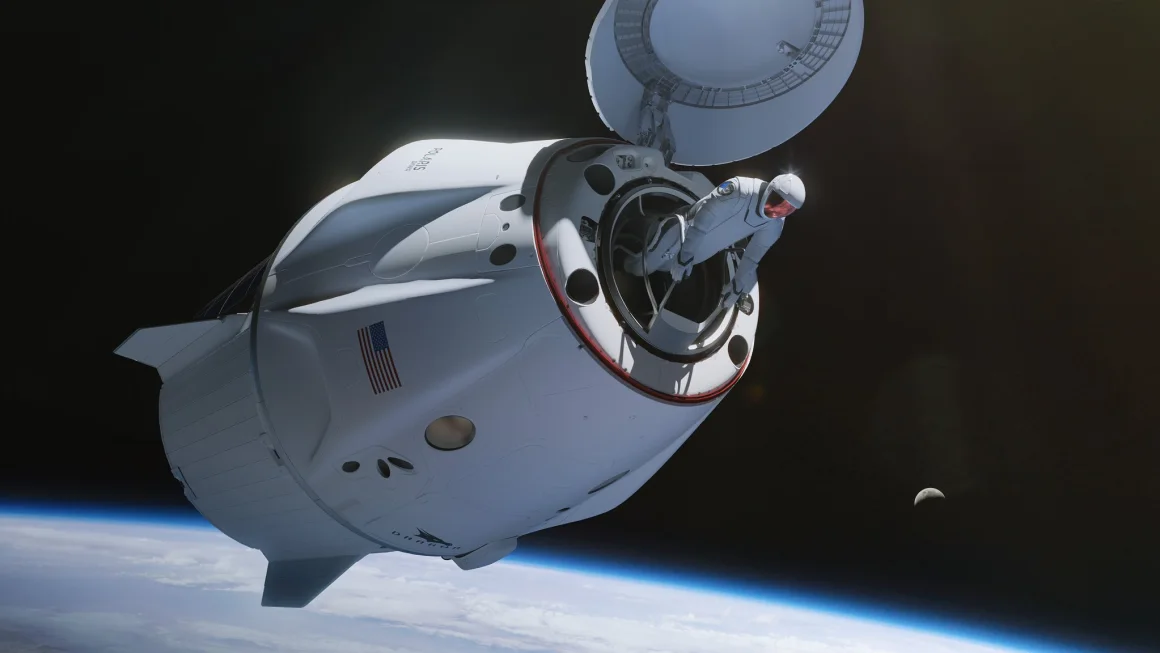
Polaris via X
Scott Poteet, who will pilot the mission, described Polaris Dawn as “the pinnacle of my flying career.” With two decades of experience as a military fighter pilot and previous experience as mission director during Isaacman’s 2021 trip to orbit, Poteet expressed gratitude for the opportunity to venture into space. His sentiments were echoed by the SpaceX engineers, Gillis and Menon, who have both played crucial roles in the company’s commercial spaceflight endeavors.
In addition to its historic objectives, the Polaris Dawn mission will also raise funds for St. Jude Children’s Research Hospital, continuing the philanthropic efforts that Isaacman championed during his previous space mission. While Isaacman has not disclosed the cost of the Polaris Dawn mission, nor the specific goals or timelines for the subsequent Polaris flights, the mission represents a significant step forward in the era of commercial space exploration.
As the countdown to launch approaches, the world watches with anticipation, eager to witness the next chapter in humanity’s journey into space, led not by government astronauts, but by private citizens pushing the boundaries of what is possible.