

A family of “grolars” in Canada’s Arctic remains the only confirmed example of hybrid offspring between polar and grizzly bears, according to a recent study, offering a glimmer of hope for conservationists concerned about the future of polar bears as a distinct species. The team of North American researchers conducted an extensive examination of bear samples collected between 1975 and 2015 using a newly developed tool designed to detect previously unknown hybrid bears.
The study, published in the journal Conservation Genetics Resources, found no new examples of crossbred polar and grizzly bears. This discovery was made possible through the use of the Ursus maritimus V2 SNP chip, a glass slide smaller than a smartphone, which was used to analyze the DNA of 371 polar bears and 440 grizzly bears from across Canada, Alaska, and Greenland.
Polar bears (Ursus maritimus) and grizzly bears (Ursus arctos horribilis) evolved from a common ancestor several hundred thousand years ago and remain genetically similar enough to interbreed. Historically, their distinct ranges kept the two species apart. However, climate change is shrinking the polar bears’ habitat, leading to increased overlap between the species.
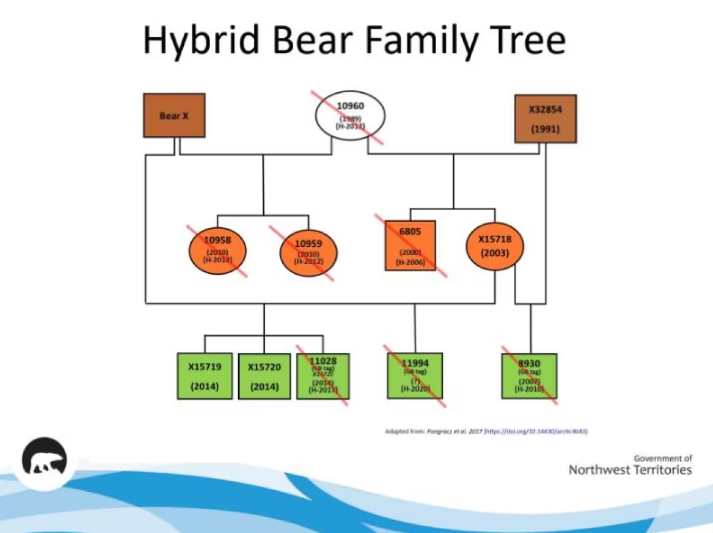
The only confirmed hybrid bears identified in the study were already known to science. They all descended from a female polar bear born in 1989 who mated with two grizzly bears on multiple occasions, producing four offspring. One of her cubs also mated with the same grizzly males, resulting in five more “grolars.”
Ruth Rivkin, a postdoctoral research fellow at the University of Manitoba and one of the study’s authors, emphasized that hybridization remains rare but expected that more examples could emerge in the future. “It’s really important that we keep monitoring these polar bears so that we can see if hybridization begins to ramp up,” she told CBC.
An increase in crossbreeding would concern conservationists, as hybrid bears may be less well adapted to survive, potentially leading to the breeding out of polar bears as a distinct species. Geoff York, senior director of research and policy at Polar Bears International, who was not involved in the report, noted, “This report underscores that hybridization is remarkably rare, and that hybridization is not an adaptive capability of polar bears.”
Compounding the challenges facing polar bears, a separate study published in Nature has warned that changing sea ice conditions are increasingly threatening their survival. The study forecasts that a community of polar bears in Hudson Bay could die out within a decade if thinning sea ice can no longer support their weight.
With longer ice-free periods restricting the bears’ ability to hunt, “extirpation for polar bears in this region may already be inevitable,” wrote the researchers from the University of Manitoba. This stark warning highlights the urgent need for continued monitoring and conservation efforts to protect these iconic creatures from the dire impacts of climate change.
As the habitat of polar bears continues to diminish, the findings from these studies underscore the critical importance of understanding and mitigating the factors contributing to their decline. Ensuring the survival of polar bears will require a concerted effort to address climate change and its profound effects on Arctic ecosystems.