

NASA is celebrating the 25th anniversary of its Chandra X-ray Observatory launch by unveiling never-before-seen photos of the largest known spiral galaxy in the universe, NGC 6872. Located in the Peacock constellation, this colossal galaxy spans over 522,000 light-years—more than five times the size of the Milky Way.
Launched on July 23, 1999, the Chandra X-ray Observatory has been a pivotal tool for astronomers, scouring the universe for X-ray emissions from exploded stars, clusters of galaxies, and more. The observatory transmits data to the Chandra X-ray Center at Harvard University’s Smithsonian Astrophysical Observatory.
Over the past quarter-century, Chandra has captured breathtaking images of the aftermath of supernovae, photographed the supermassive black hole at the center of the Milky Way, and provided invaluable insights into dark matter, dark energy, and black holes. “For a quarter century, Chandra has made discovery after amazing discovery,” said Pat Slane, director of the Chandra X-ray Center, in a NASA news release. “Astronomers have used Chandra to investigate mysteries that we didn’t even know about when we were building the telescope—including exoplanets and dark energy.”
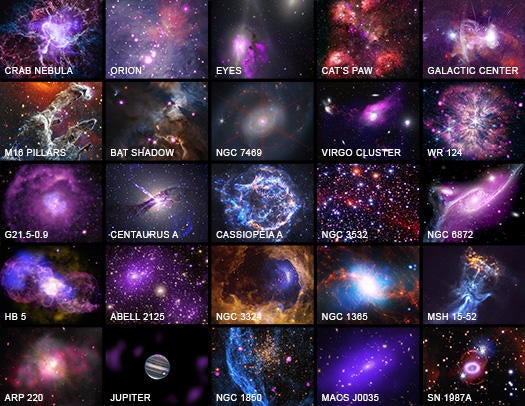
The observatory has captured thousands of images of NGC 6872, showcasing a stunning swirl of red, blue, and purple hues. These new images highlight the observatory’s capability to provide detailed views of cosmic phenomena. Among the solar objects featured in the 25 released images are the “Crab Nebula” and Cassiopeia A, supernova remnants known for their striking appearances and vast sizes. The observatory has also captured images of the planet Jupiter, further demonstrating its versatility.
“On behalf of the STS-93 crew, we are tremendously proud of the Chandra X-ray Observatory and its brilliant team that built and launched this astronomical treasure,” said Eileen Collins, commander of the space shuttle Columbia mission that launched Chandra into space in 1999, in NASA’s news release. “Chandra’s discoveries have continually astounded and impressed us over the past 25 years.”
Since its launch, Chandra has significantly advanced our understanding of the universe, contributing to the discovery of exoplanets and providing new insights into the nature of dark energy. The observatory’s ability to capture high-resolution X-ray images has enabled scientists to study the universe in ways that were previously unimaginable, revealing the intricate and dynamic processes that shape our cosmos.
As NASA celebrates this milestone, the newly released images of NGC 6872 and other celestial phenomena serve as a testament to Chandra’s enduring legacy and its critical role in the field of astrophysics. These images not only highlight the beauty and complexity of the universe but also underscore the importance of continued exploration and scientific discovery.