

The next space station astronaut crew may be the last to splash down in the ocean near the U.S. East Coast. The Crew Dragon Crew-9 mission, with astronauts scheduled to launch to the International Space Station (ISS) no earlier than Aug. 18, could become the final NASA-led ISS mission to arrive in the Atlantic Ocean aboard Crew Dragon.
Repeated issues with large chunks of debris from Dragon — specifically the “trunks” where the fuel and electrical supplies are held — have caused debris to crash down in areas ranging from Australia to North Carolina. To address this issue, SpaceX announced during a press conference today (July 26) that future spacecraft after Crew-9, potentially starting as soon as Crew-10, will splash down on the U.S. Pacific Coast.
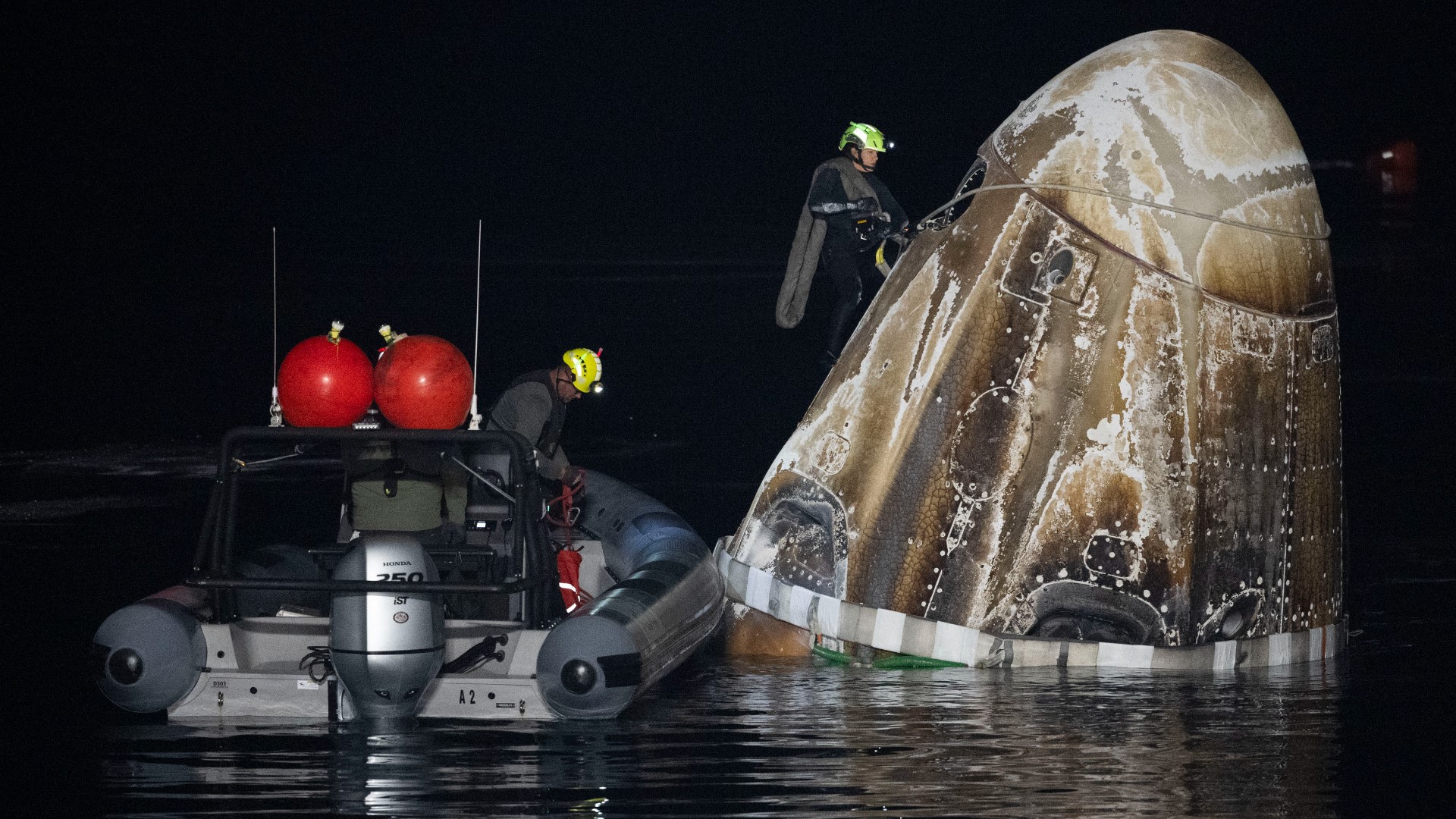
Teams work around the SpaceX spacecraft shortly after it landed in the Gulf of Mexico off the coast of Pensacola, Fla., March 12, 2024 | Credit: Joel Kowsky/NASA via AP
Sarah Walker, SpaceX’s director of Dragon mission management, explained during the livestreamed briefing, “What we’ll do is we’ll implement a software change to complete the deorbit burn before jettisoning the trunk, like we did with Dragon-1, and then the trunk will intentionally land in an unpopulated area of the ocean.” She added that a Dragon recovery vessel would be moved to the Pacific sometime next year. This change not only reduces space junk but also takes advantage of the Pacific Coast’s relatively calmer weather and fewer hurricanes, which could add more predictability for scheduling the end of crewed missions.
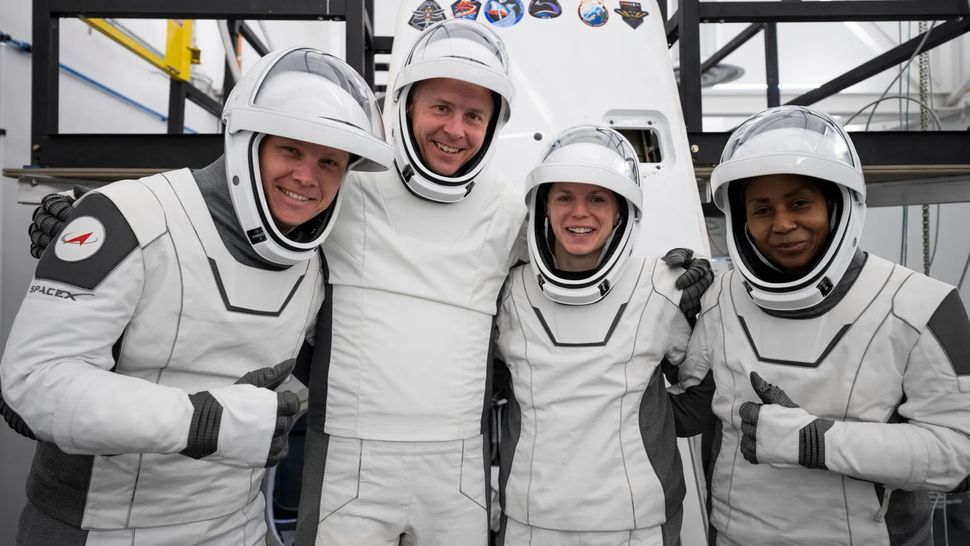
The four astronauts on board Crew-9 include commander Zena Cardman (NASA), pilot Nick Hague (NASA), mission specialist Stephanie Wilson (NASA), and mission specialist Alexsandr Gorbunov (Roscosmos). Crew-9 will only fly to space once NASA approves Falcon 9 for ISS launches again. All is proceeding so far for an Aug. 18 liftoff, despite a Falcon 9 second-stage failure on July 11 due to an oxygen leak during a Starlink satellite launch. SpaceX has resolved the issue with the Federal Aviation Administration (FAA) and plans to resume launching missions as soon as Saturday (July 27).
NASA confirmed that the fixes the FAA approved will be implemented before the space agency’s program control board for Crew-9. Steve Stich, NASA’s program manager for commercial crew, expressed confidence in SpaceX’s work, saying, “We understand exactly what they’ve [SpaceX] done.”
It has been a busy month for the ISS. Boeing Starliner engineers continue investigating issues encountered during the docking of the first test astronaut mission on June 5. Ground tests revealed problems with thruster insulation and propulsion flow that likely affected the approach to the ISS. NASA and Boeing are working on resolving these issues before Starliner can begin operational six-month ISS missions starting as soon as 2025.
NASA astronauts Butch Wilmore and Suni Williams, currently more than 50 days into what was supposed to be a 10-day mission aboard the ISS, have had their return delayed as NASA and Boeing address the thruster problems and helium leaks in the propulsion system. The astronauts have been living off a four-month reserve of supplies on the ISS. Their personal items, initially pulled off from Starliner to make room for a critical ISS part, will arrive on a Northrop Grumman Cygnus cargo spacecraft aboard a Falcon 9, set for no earlier than Aug. 3.
“There are any number of challenges that we can face that result in a shortage of supplies on board, for example, if you have a cargo flight that slips out [delays],” explained ISS program manager Dana Weigel, highlighting the importance of maintaining a reserve of essential items such as clothing, food, water, oxygen, nitrogen, and other critical supplies. “We had plenty of generic supplies on board,” Weigel noted, adding that Wilmore and Williams have been using those supplies.
This change in splashdown location to the Pacific Coast marks a significant shift in SpaceX’s approach to ensuring the safety and predictability of their crewed missions while minimizing the environmental impact of space debris.